I wanted to follow up on last week's post about the power of the friend recommendation. I'm convinced that this needs more investigation.
It reminded me to take another look at Goodreads. I signed up for this site a few weeks ago when I was prompted by a Facebook invitation from a friend. Interestingly enough, my husband had verbally encouraged me to join several months earlier, but it took that live prompt via Facebook from another friend before I finally got round to checking it out. That says something itself about how influential an online peer recommendation is: I didn't take the advice verbally given by my best friend, but I did take the offer when it was made simple for me by taking me straight from invitation link to online registration.
Once that initial hurdle is dealt with, what about registration itself? Goodreads uses the same authentication that a lot of sites now use to make this as easy as possible: Facebook Connect. This is doubly clever. For one, it again makes the whole process less burdensome as I only have to confirm my details, rather than enter them all in from scratch. And (even smarter) Goodreads now gets something much more valuable in return for my registration: an easy brand advocate. With no effort on my part, Goodreads prompts me to tell all my Facebook friends, and invite them to join too.
On the whole, the interface for registration is (probably on purpose) confusing. I wouldn't have actually invited everybody I'm connected to on Facebook had I understood what it was I was being prompted to do, but I was being too lazy to interrogate the interface so just kept clicking to get through the process quickly. However having already spammed all my Facebook contacts, here's an interesting little social experiment at work, as my theory (that you follow up on recommendations from your friends) gets tested as I can then see who goes on to register in turn for a Goodreads account. Several do. Several also display that same idiocy which I had and go on to spam their entire Facebook friends list. And so this goes on and on...
If it's so easy to make a brand advocate, why shouldn't more online businesses make use of this to promote their goods and services? I did nothing to become an advocate for Goodreads except click on a link (which I didn't even read). I'm not saying that such behaviour is actually a healthy or long-term conversion to brand advocacy, but oftentimes it's that initial contact that is the hardest to make. Getting people to stick around is definitely a challenge too (and I'll come back to that point more in future posts), and good functionality, good design, good content and good user journeys is all crucial.
For now, I'm still playing around with Goodreads: it doesn't do much for me, but I'm interested to see that several of the friends I "recommended" it to are using it: in fact two have just told me today that they are using it and finding it valuable. So that in turn has prompted me to go back and give it another look. Oh, look! There's that friend recommendation working all over again :)
Sunday, 3 February 2013
Sunday, 27 January 2013
Peer to peer recommendations - still important?
A few years back (2007) I completed the CIPR's postgraduate diploma in Public Relations. Part of that was undertaking a dissertation, and my chosen topic was on the value of social media for peer to peer recommendations for PR. I kept up a blog on the work at the time so feel free to check it out, although clearly no longer active.
The premise I had at that time was the effects that marketing research had shown for Word Of Mouth (WOM) could be harnessed by businesses using social media. People like hearing what their friends value, what they are buying, reading, eating.
Things have moved on a fair bit since 2007. According to the TripAdvisor website, there are now more than 75m individual reviews about hotels, restaurants or other travel-related guidance on their site. It's no longer just a small subset of in-the-know techies writing the reviews; it is you and me, your friends and even your parents. Amazon will prompt to you revisit and rate products you have purchased. Unlike 'review', 'rate' asks little of you as a customer, thereby further increasing the likelihood you will respond. Most ecommerce sites will also provide you with "share" options to tell all your friends about the service you have just used. Again, this is asking very little of you as a customer, and provides that business with a brand advocate without any investment of time or effort.
Mashable recently posted a somewhat sceptical piece on the current value of a LinkedIn endorsement. It suggested that the service has made it so easy to just hit a button and endorse for skills that the reader - be they recruiter or potential business associate - has no way of validating whether those recommendations are genuine or just the result of someone logrolling (giving in expectation of the same favour in return). If you apply that same logic to the rating options on other websites, do brands still benefit from providing this as a way of showing peer to peer recommendations? Do we, as consumers, see this as valuable, and does it affect our purchasing decisions?
I have begun to consider whether there is the same value in "peer to peer" review as I had originally suggested, and whether instead it's time to discuss the value of "friend to friend" review. Going back to the huge increase in users of peer to peer review sites such as TripAdvisor or TopTable or CheckATrade, do we (as potential customers) still hold these views of strangers to be valid? I know I'm not the only one to have been paralysed by checking out a hotel over and over on TripAdvisor then getting to the hotel and had a fantastic time anyway. Similarly with Amazon reviews: reading is subjective; just because one person hasn't enjoyed a title, why shouldn't you?
I'm not saying I don't believe these review services offer value. There is always value in seeing crowdsourcing as a measure of popularity: if a restaurant gets 50 five star ratings, there is a good chance that it will be better than the restaurant next door with 50 one star ratings. What I am saying is could there be something even more valuable on offer if we start to look at a more granular level at who these people are?
TripAdvisor already does this to some extent by allowing for filtering by type of review: romantic, business, family etc. This goes back to the original premise of 'peer to peer' social media WOM for PR, which was that you are influenced in purchasing decisions by 'other people like me'.
This is intensified if those reviews are from the people we actually know are like us, in other words our friends. Consider for example services like Spotify where you are connected in with Facebook friends, seeing what tracks they are listening to. You are much more likely to only be connected to people you genuinely 'know' on Facebook. At least much more so than we 'know' our Twitter contacts, or know any of the people whose reviews we are reading on TripAdvisor.
So how much more powerful could these recommendation services become when we start looking at what our genuine friends, with whom we know we share interests, are sharing? And could we begin to look at how to harness this network even further for brand advocacy?
More to come on this topic over the coming weeks.
The premise I had at that time was the effects that marketing research had shown for Word Of Mouth (WOM) could be harnessed by businesses using social media. People like hearing what their friends value, what they are buying, reading, eating.
Things have moved on a fair bit since 2007. According to the TripAdvisor website, there are now more than 75m individual reviews about hotels, restaurants or other travel-related guidance on their site. It's no longer just a small subset of in-the-know techies writing the reviews; it is you and me, your friends and even your parents. Amazon will prompt to you revisit and rate products you have purchased. Unlike 'review', 'rate' asks little of you as a customer, thereby further increasing the likelihood you will respond. Most ecommerce sites will also provide you with "share" options to tell all your friends about the service you have just used. Again, this is asking very little of you as a customer, and provides that business with a brand advocate without any investment of time or effort.
Mashable recently posted a somewhat sceptical piece on the current value of a LinkedIn endorsement. It suggested that the service has made it so easy to just hit a button and endorse for skills that the reader - be they recruiter or potential business associate - has no way of validating whether those recommendations are genuine or just the result of someone logrolling (giving in expectation of the same favour in return). If you apply that same logic to the rating options on other websites, do brands still benefit from providing this as a way of showing peer to peer recommendations? Do we, as consumers, see this as valuable, and does it affect our purchasing decisions?
I have begun to consider whether there is the same value in "peer to peer" review as I had originally suggested, and whether instead it's time to discuss the value of "friend to friend" review. Going back to the huge increase in users of peer to peer review sites such as TripAdvisor or TopTable or CheckATrade, do we (as potential customers) still hold these views of strangers to be valid? I know I'm not the only one to have been paralysed by checking out a hotel over and over on TripAdvisor then getting to the hotel and had a fantastic time anyway. Similarly with Amazon reviews: reading is subjective; just because one person hasn't enjoyed a title, why shouldn't you?
I'm not saying I don't believe these review services offer value. There is always value in seeing crowdsourcing as a measure of popularity: if a restaurant gets 50 five star ratings, there is a good chance that it will be better than the restaurant next door with 50 one star ratings. What I am saying is could there be something even more valuable on offer if we start to look at a more granular level at who these people are?
TripAdvisor already does this to some extent by allowing for filtering by type of review: romantic, business, family etc. This goes back to the original premise of 'peer to peer' social media WOM for PR, which was that you are influenced in purchasing decisions by 'other people like me'.
This is intensified if those reviews are from the people we actually know are like us, in other words our friends. Consider for example services like Spotify where you are connected in with Facebook friends, seeing what tracks they are listening to. You are much more likely to only be connected to people you genuinely 'know' on Facebook. At least much more so than we 'know' our Twitter contacts, or know any of the people whose reviews we are reading on TripAdvisor.
So how much more powerful could these recommendation services become when we start looking at what our genuine friends, with whom we know we share interests, are sharing? And could we begin to look at how to harness this network even further for brand advocacy?
More to come on this topic over the coming weeks.
Sunday, 13 January 2013
How do you generate your ideas? Lessons from dance
So the last two weeks for me have mostly been about using every spare minute to start setting out ideas for my new choreography project, Anything Goes, which is on at the New Wimbledon Theatre this June.
People often ask me how easy it is to do choreography, or where/how I learned how to do it. Part of it was an obvious transfer of skills: I first started teaching kids to dance at my local ballet school when I was 14. At that stage, I was being taught a routine, then being given responsibility to re-teach that dance to a large room full of small girls and boys. That was fairly easy as, by that stage of my own dance training, I'd been taught to pick up new combinations of steps pretty quickly. Layering on from that, i.e. from remembering an order of steps, as a junior teacher I was then learning how to pass on knowledge about how to recreate those steps. You learn how to break down an action into its most basic component parts so that people learning from you can see how to build it back up.
Those two parts are the fundamentals of dance teaching. The last layer for choreography is then of course the creative part: listening to a piece of music and feeling what movement would look good/express effectively what is happening to a viewing audience.
You first start learning to express to music pretty much the first time you go to a dance class, aged as young as three. They will put on a piece of classical music and tell you to "be a fairy", or "be a monster", and you will throw your little self around, twirling, hopping and crouching for the thirty seconds or so until the track ends. It's essentially just another kind of creative play, which young children do extensively as part of learning and development. It's imaginative, not to mention a lot of fun as you learn to be completely individual (and generally at aged 3 you're not learning to twirl, just point your toes, so that's great too).
Most of us lose the opportunity to be truly creative as time goes on. But having an outlet for creative expression is such a joy. Everyone should have something - whether that's dance, writing, cooking, music, craft or something completely different. I think people sometimes have a fear of being creative, or think that they can't do it. But I honestly think that it's the same as anything else; you get better at it the more you do it.
I'm completely in awe of great choreographers. A great piece of theatre makes you literally gasp. I can remember sitting open-mouthed through some great productions over the years, my heart beating faster, my spine tingling, my toes tapping. I would never claim to be as good as anyone who does this for a living, and consider myself lucky to have had so many opportunities to do this on an amateur basis. I can't claim to have had any formal training, and couldn't claim that how I do it is the "right" way. But this is how I do it, and it's worked ok for me over the years!
By the time I left home at 18, I was regularly teaching new routines to other children at my dancing school: single dances for exams, larger group dances for theatre performances, as well as drama classes. For each new thing, I would be listening to the track, and "hearing" what sorts of steps would fit with that music. I'd also be thinking about the style of the music, drawing on influences from that genre. Most often with this kind of dance it was purely about expressing the feel of the music rather than a huge amount of story telling.
It was when I got to university and moved into more choreography for stage shows - mostly musicals - that I began to also think about how what was happening in a dance reflected the story that was being told. I'd be looking at similar stories told through dance, researching styles on the web, looking back at dance DVDs, and reading what I could from the text if there was a song as part of the music. I'll spend a lot of time sitting, thinking about a piece before I'll even get up and try any combinations out. I'll also draw a lot on influences from other dances I have seen, taking combinations of steps and re-weaving them in a way that fits for the new thing I'm working on. I'll also be thinking about the stage available: looking at patterns and shapes that will make something visually pleasing to someone watching.
Thinking about it, there are a lot of parallels in coming up with dance ideas to any other new creative process. Generating new ideas relies on a combination of:
People often ask me how easy it is to do choreography, or where/how I learned how to do it. Part of it was an obvious transfer of skills: I first started teaching kids to dance at my local ballet school when I was 14. At that stage, I was being taught a routine, then being given responsibility to re-teach that dance to a large room full of small girls and boys. That was fairly easy as, by that stage of my own dance training, I'd been taught to pick up new combinations of steps pretty quickly. Layering on from that, i.e. from remembering an order of steps, as a junior teacher I was then learning how to pass on knowledge about how to recreate those steps. You learn how to break down an action into its most basic component parts so that people learning from you can see how to build it back up.
Those two parts are the fundamentals of dance teaching. The last layer for choreography is then of course the creative part: listening to a piece of music and feeling what movement would look good/express effectively what is happening to a viewing audience.
![]() |
| Me, appearing in Follies, 2008 |
Most of us lose the opportunity to be truly creative as time goes on. But having an outlet for creative expression is such a joy. Everyone should have something - whether that's dance, writing, cooking, music, craft or something completely different. I think people sometimes have a fear of being creative, or think that they can't do it. But I honestly think that it's the same as anything else; you get better at it the more you do it.
I'm completely in awe of great choreographers. A great piece of theatre makes you literally gasp. I can remember sitting open-mouthed through some great productions over the years, my heart beating faster, my spine tingling, my toes tapping. I would never claim to be as good as anyone who does this for a living, and consider myself lucky to have had so many opportunities to do this on an amateur basis. I can't claim to have had any formal training, and couldn't claim that how I do it is the "right" way. But this is how I do it, and it's worked ok for me over the years!
By the time I left home at 18, I was regularly teaching new routines to other children at my dancing school: single dances for exams, larger group dances for theatre performances, as well as drama classes. For each new thing, I would be listening to the track, and "hearing" what sorts of steps would fit with that music. I'd also be thinking about the style of the music, drawing on influences from that genre. Most often with this kind of dance it was purely about expressing the feel of the music rather than a huge amount of story telling.
It was when I got to university and moved into more choreography for stage shows - mostly musicals - that I began to also think about how what was happening in a dance reflected the story that was being told. I'd be looking at similar stories told through dance, researching styles on the web, looking back at dance DVDs, and reading what I could from the text if there was a song as part of the music. I'll spend a lot of time sitting, thinking about a piece before I'll even get up and try any combinations out. I'll also draw a lot on influences from other dances I have seen, taking combinations of steps and re-weaving them in a way that fits for the new thing I'm working on. I'll also be thinking about the stage available: looking at patterns and shapes that will make something visually pleasing to someone watching.
Thinking about it, there are a lot of parallels in coming up with dance ideas to any other new creative process. Generating new ideas relies on a combination of:
- Research: identifying what has worked successfully for others before
- Learning by example: building on the above, I feel no shame in saying I am inspired by great work I see others do, and use that as inspiration for my own creative direction
- Auditing: consideration of needs, motives, what is the message trying to be put across
- Brain-storming: you'll come up with as many crap ideas as you do good ones, but that's an inevitable part of any creative process
- Chunking: I'm a massive fan of breaking down something large into many smaller parts (see previous comments on this): tackling small sections makes a difficult project more manageable
- Setting structure: the chunks need to hang together as a whole: taking a bird's eye view is important in all projects before you start to lay anything out. In dance I do this by story-boarding before I choreograph anything
- External feedback: if I'm ever really unsure, getting third party feedback is always a safe bet. It's likely that you'll also be able to improve your ideas by shaping and building on what you already have with a fresh perspective from someone else.
Wednesday, 2 January 2013
New beginnings
A very Happy New Year!
It's fair to say that 2012 isn't a year that I'll look back on with great fondness. Turning thirty brought along with it a lot of soul searching, and wondering about whether I'd achieved everything that I'd intended to in my twenties. That said, I have a habit of dwelling on the things I'm less pleased with than I do on those that I am proud of. So I wanted to take a moment to remember what was great in 2012. Not least of all because I am incredibly thankful for all these experiences, but also because this gives me a chance to consider how to keep - and to mobilise - all that was good in what I hope will be a wonderful 2013.
- Getting back into reading. At the start of last year, one goal I set myself was to read more, and that included stretching myself, reading outside of my comfort zone and being open to new genres. This has truly been a pleasure. Buying the iPad back in 2011 played a significant factor in enabling me to constantly have a book (or more than one) on the go at any time. I have forced myself to read in genres I wouldn't otherwise have considered, and as a result have enjoyed amazingly rich experiences. Notably I have really enjoyed reading about personal experiences in Marketing, and that's an area I'd look to find more good titles in. Access to Audible through 2012 was another really rich experience, which I had been very sceptical about when I first got started. Here, what I've found especially interesting are stories told by the author themselves. So biography is a genre I'm really beginning to enjoy more. One thing I didn't do enough of is write short reviews on every title. I have a small regret about that and it's something I'd like to get better at in 2013.
- Self-improvement. A key part of the above was focusing on developing my personal skills - about a fifth of the books I read this year I selected to challenge me to think about my communication, management and leadership. From Covey's seven habits, to selected psychology, to transactional analysis, these all provided ample food for thought. I'm including a full list of my reading from the year here.
- Curtains. This Kander and Ebb show was without a doubt one of the most exciting I've ever worked on. As joint choreographer for the Wimbledon Light Opera Society's production back in May, I was so proud of the team and cast - it's a wonderful show that I thoroughly loved being a part of. With the new year I'll be starting rehearsals for our next production: Anything Goes. I'm already looking forward to this so much.
- Granada. For my birthday I planned an escape to a city I have longed to visit since I first read about the beautiful moorish palace, the Alhambra, a few years ago. The trip was brief, but felt like a few days in paradise nonetheless. Advice to anyone considering it: stay in the old quarter, it still has that charm and sense of being lost in time. Leave a whole day for exploring the Alhambra. It's enormous, and beautiful. Make the most of the fabulous and inexpensive Cava.
- Podcasting. For SAGE, there was certainly a lot about podcasting this year! Although not recording them myself, it was great to learn a lot about the process, the hosting, and the promotion for two new series. As with audio books, podcasting really isn't something I'd had much previous interest in. Learning about what's available was eye-opening.
- Blogging. Getting back into blogging regularly isn't easy when there's always something else that needs to get done. But the impetus of being listed by the Guardian late in the year was the kick I needed to make this high on the priority list. I've also committed to taking on the CIPR Education and Skills group blog and website for 2013. That's a challenge that I anticipate will keep me focused on what's important for Public Relations in HE in a much deeper way, and help my development as much as it provides a service for the wider PR community!
- Eating! Dan and I enjoyed some intense culinary adventures in 2012, not least of all our summer vacation in the Lake District, where we sampled three Michelin-starred restaurants over the course of our five nights in Windermere. Cooking and eating great food is a luxury but provides a lot of enjoyment, and I'm very fortunate to have been able to do so much of it this last year.
- Zumba. I have to admit, I was really not looking forward to starting a generic exercise class, but in the absence of a show to work on in the second half of the year I took up Zumba, and have thoroughly enjoyed it. I've been lazy and undisciplined at the end of the year, but will be doing my best to get to a class a week whenever I can, outside of the rehearsal schedule for Anything Goes.
- Networking. Both for work directly and for professional PR networking, there have been some fantastic opportunities during 2012 to meet like-minded contacts, building existing connections and establishing new ones. It's such an important way to stay on top of trends, ensure best practice, and importantly just to remind yourself that you are not alone! I've been grateful for the many self-affirming conversations I've had through these events over the year.
- Turning thirty. So I did start the post by commenting on the dissatisfaction I felt at turning Thirty in 2012. But it was also a year of many 30th birthdays, a lot of celebrating and seeing good friends. It's good to step back and evaluate from time to time, but not to dwell. This has been a hugely positive time for me, and if anything it's made me determined to take risks, do new things, be more confident, say yes more!
I'll start the new year by looking back at just one more 'new thing' from 2012: my first (probably last too) flash mob, helping a complete stranger propose to his girlfriend. A friend received an email out of the blue, asking for singers to help him propose by singing 'their song' to his girlfriend while he proposed. Ever suckers for romance, we got together, rehearsed this number. We posed as tourists in Trafalgar Square on a cold October evening, springing on the couple as they returned from a trip to the theatre. You can see from the video the genuine surprise and delight! I can honestly say it will go down as one of the nicest things I've ever had the chance to do for someone else and reminded me how lucky I am to have someone to love too. Disgustingly soppy I know, but I've a lot to be thankful for. Enjoy:
Monday, 3 December 2012
Getting the most out of attending conferences
I spent today at another fascinating conference. Today it was the British Library's 'taking a long view on the impact of the social sciences'. For anyone not familiar with SAGE, social science is the backbone of our company and key to our mission, so immersing myself in the debates both last week and this has been fantastic.
Ordinarily I don't get out of the office all that often, but whenever I do I am strongly reminded of how important events like this are, and how valuable face to face dialogue remains even in a digital age. Building relationships is such an important part of PR, and it really is important to use the limited time we get for face to face engagement effectively.
I've blogged a little before tangentially about conferences, but tonight it felt appropriate to reflect back on making the most of the in-person event, including where and when to incorporate online tools. It should be noted that these are just my views: other tips and tricks are of course plentiful, and comments are welcomed.
- Get a delegate list. Obvious, but it helps so much to have had a chance to digest who is going to be attending the event with you. More often than not I'll set up a spreadsheet to examine the whole delegate list, googling names I think I know but can't remember where from, or to add background information for people I want to pick up a conversation with. Additionally it is a great way to ensure that (as the PR Manager for my company) I've prepared an adequate brief for anyone else from my senior team that might be participating. Pulling out the key influencers makes sure they make good use of their time away from the office.
- Check what the social media landscape is for the conference beforehand. More often than not, a conference will have an established #tag set up for the event a while before it takes place, or set up a Facebook or LinkedIn group, allowing for additional networking before delegates even arrive. See point 1), then use point 2) to really maximise the networking opportunities that this presents: you can see what people are planning to talk about, arrange to meet up with like-minded delegates, or even get questions in ahead of getting into a session.
- Network! Let's be frank, I HATE networking. As an introvert, the prospect of making small talk makes my insides turn over. But it's a necessary part of my job and one that anyone that wants to work at a more senior level in PR must be able to do. So my tips on doing this well? Well tips 1) and 2) are really excellent contributors to this! Again, as an introvert, having a text-based conversation, where I feel more at ease with myself, makes it possible to avoid that awkward "umm..hi!" and cuts straight to the "so I totally agree with that blog post you wrote last night." Also it never hurts to be up to speed on relevant industry headlines and issues, so you can join in with the discussion without fumbling for a point of view. Trust me if you're an extrovert and find that these sorts of things come naturally: for an introvert, being put on the spot really is painful. Other tips? I have to say I've found it much easier with practice than when I was younger: it's now less traumatic to just go up to a group and say "Hi can I join you?" Generally people are nice, and receptive to an introduction. I've met some really interesting and useful contacts this way that have often been unexpected. What also works well is listening out for the people who ask interesting questions in a particular session, mentally recording what they look like, then finding a way to chat to those attendees during a break or by finding them during another session. And the last networking tip merits a point all of its own:
- Plug into the digital conversation. I blogged recently about my own particular Twitter issues, but as I mentioned in that post, engaging in the conference back channel discussion on Twitter really is valuable. With relation to point 3), you get to meet a huge range of delegates and hear their views before you've had a chance to physically engage with them. As above that further reduces the need for small talk and ensures you can immediately have some great conversations with those people when you do meet face to face. Beyond networking, I also find the Twitter back channel a great way of re-emphasising the most important nuggets from a conference: it distills the sessions in a way that can trigger your memory after the event too, with tools like Storify and archiving tools collating the tweets into permanent conference notes.
- Swap contacts. Old school style: swap your business card. Digital style: follow your new contacts on Twitter, connect to them on LinkedIn or other networks, or super techy maybe you can bump them. Whichever method you choose, don't let the link go cold: get in touch as soon as you can after the conference ends. Which reminds me: after four days out I've got some jobs to do...
Thursday, 29 November 2012
Where am I? The missing hashtag participation mystery
This has been bugging me for a while.
For those of you who use Twitter, it's not uncommon to participate in a Twitter #tag as a back-channel to in-person conferences. For example today I was on#acssfinch whilst attending a two-day conference on open access. A few weeks ago I was participating on #solo12 whilst at the Spoton conference. And interestingly one of the sessions at Spoton was actually the value of using social media channels as part of a conference: video online here.
I find tweeting through a conference, plus following others tweeting on the hashtag, a great way to get a rounded view of the session I'm in. It also gives me a great summary of the event after I've returned home. Sometimes I've even storified the tweets from events to create a permanent summary of those tweets as a narrative.
So you can imagine my frustration, when I have been tweeting like a MACHINE through a conference, to discover that the tweets I've been tagging are not appearing in the tweet stream.
Why? Is it something I said? Where am I hiding?!
Having frustratingly been invisible on my tweet stream today, I thought it was time to get to the bottom of this. Guess what? I can't.
The Twitter help page gives some suggestions on why someone would not appear in search:
On the viewer side of things: if you're viewing only top results you will be missing some tweets. Similarly not all tweets show up on a mobile.
On the tweeter side: If you have protected tweets, again these will not show up. Apparently infrequent tweeters don't appear, and neither do people with incomplete profiles. New accounts may not show up either.
But I'm none of these things!!
So here's some more thoughts from across the blogosphere:
For those of you who use Twitter, it's not uncommon to participate in a Twitter #tag as a back-channel to in-person conferences. For example today I was on
I find tweeting through a conference, plus following others tweeting on the hashtag, a great way to get a rounded view of the session I'm in. It also gives me a great summary of the event after I've returned home. Sometimes I've even storified the tweets from events to create a permanent summary of those tweets as a narrative.
So you can imagine my frustration, when I have been tweeting like a MACHINE through a conference, to discover that the tweets I've been tagging are not appearing in the tweet stream.
Why? Is it something I said? Where am I hiding?!
Having frustratingly been invisible on my tweet stream today, I thought it was time to get to the bottom of this. Guess what? I can't.
The Twitter help page gives some suggestions on why someone would not appear in search:
On the viewer side of things: if you're viewing only top results you will be missing some tweets. Similarly not all tweets show up on a mobile.
On the tweeter side: If you have protected tweets, again these will not show up. Apparently infrequent tweeters don't appear, and neither do people with incomplete profiles. New accounts may not show up either.
But I'm none of these things!!
So here's some more thoughts from across the blogosphere:
- I'm a spammer? If twitter sees you tweeting the same links or tweeting the same content across multiple accounts they can mistake you for a spammer. Hmm, I do tweet on the company accounts, but is that really it?
- I'm using too many third party services: Quora reckons if you use a number of third party tweet apps, you'll also get blocked. Great, I'm definitely in that category, but that sounds plain crazy.
I love using Twitter to participate in live dialogue at events, and even though I'm not appearing in results, people who follow me can still see what I'm tweeting. It does however prevent me from really engaging with the other conference participants, and inevitably also means I'm not contributing to the discussion. I'm not alone: other colleagues have experienced the same issue, and there's a lot of internet forum discussions on this topic. If it's a problem for you too, send Twitter a complaint here!
Sunday, 25 November 2012
Some thoughts on crowdfunding
This week's been fairly exciting in the Lucraft house, driven by the launch of Songkick's Detour initiative. So exciting in fact that, deep in conversation, Dan and I missed our train station on Tuesday night and ended up trekking through leafy Surrey in the rain trying to find our way back home...
If you are unfamiliar with Songkick, in a nutshell they make it easy for you to track bands you want to see play. This new launch is part of a growing trend of crowd-sourced funding projects, or 'crowdfunding.' In essence, pay Songkick upfront for tickets to a gig that you want to make happen. If enough people all do the same, that gig will then take place. Neat idea for fans of less mainstream artists that might not otherwise be willing to take the risk of booking a gig. This is guaranteed business: the customers have said they will pay, so the risk is removed.
The Songkick project comes not long after the launch of Kickstarter in the UK. Perhaps the best known crowdfunding site, the US version of Kickstarter launched in 2009. According to their site, since then:
In a world where new businesses can really struggle to reach sustainability, why wouldn't you start by having those people that want to buy your stuff fund your set up?
What does this mean for my industry? A search on Kickstarter brings back 340 projects in publishing. For authors in niche areas, this could have huge implications for choosing to self-publish. Before any production work is undertaken, they can identify who is going to buy their book. For the scholarly author, notably the monograph author where it isn't uncommon to sell only 50 copies of a title, this is clearly significant.
But (and this is a big but) not all projects will get funded: there are time periods set, and if funding goals are not reached, the project doesn't go ahead.
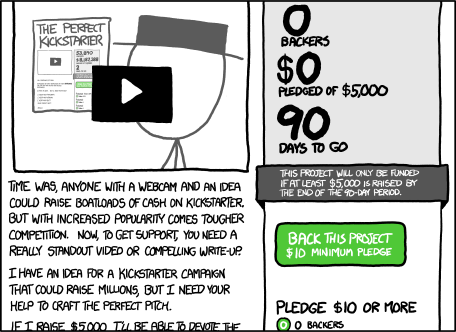
So this is the most significant point, from my point of view as a PR/Marketeer. To me, the benefits of crowd-funded projects are plainly sensible, but I can see that the model benefits businesses as well as individuals. There will, I believe continue to be an important role for publishers, and notably in providing the promotion and marketing of a project to enable it to stand out from the crowd. The XKCD cartoon above says it all: not only will you need a Kickstarter listing, your Kickstarter page has to be more awesome than every other page on the site if you want anyone to sit up and take notice.
In an environment where there's a lot of criticism over what 'value' publishers bring, expertise and scale in getting the word out about a project will be what makes some initiatives succeed where others fail. It's all well and good suggesting that 'anyone' can do this. Sure, anyone can set up a blog and have a presence, anyone can have a twitter feed and make their virtual presence felt. But there will only ever be a few who really achieve that success. For the majority, the experts in PR and Marketing will continue to play a really valuable role.
There's also potential here for publishers in supporting new authors or niche areas: drive selection via the buyers, then invest in the high quality production and add on services once there's a clear demand.
I'm excited to see where and how this evolves.
If you are unfamiliar with Songkick, in a nutshell they make it easy for you to track bands you want to see play. This new launch is part of a growing trend of crowd-sourced funding projects, or 'crowdfunding.' In essence, pay Songkick upfront for tickets to a gig that you want to make happen. If enough people all do the same, that gig will then take place. Neat idea for fans of less mainstream artists that might not otherwise be willing to take the risk of booking a gig. This is guaranteed business: the customers have said they will pay, so the risk is removed.
The Songkick project comes not long after the launch of Kickstarter in the UK. Perhaps the best known crowdfunding site, the US version of Kickstarter launched in 2009. According to their site, since then:
...over $350 million has been pledged by more than 2.5 million people, funding more than 30,000 creative projects.Staggering. Yet so plainly sensible. People have astoundingly good ideas, but don't have access to the funds to make those ideas real. Individuals can review what these ideas are, and provide support to those they would want to have access to as a consumer.
In a world where new businesses can really struggle to reach sustainability, why wouldn't you start by having those people that want to buy your stuff fund your set up?
What does this mean for my industry? A search on Kickstarter brings back 340 projects in publishing. For authors in niche areas, this could have huge implications for choosing to self-publish. Before any production work is undertaken, they can identify who is going to buy their book. For the scholarly author, notably the monograph author where it isn't uncommon to sell only 50 copies of a title, this is clearly significant.
But (and this is a big but) not all projects will get funded: there are time periods set, and if funding goals are not reached, the project doesn't go ahead.
So this is the most significant point, from my point of view as a PR/Marketeer. To me, the benefits of crowd-funded projects are plainly sensible, but I can see that the model benefits businesses as well as individuals. There will, I believe continue to be an important role for publishers, and notably in providing the promotion and marketing of a project to enable it to stand out from the crowd. The XKCD cartoon above says it all: not only will you need a Kickstarter listing, your Kickstarter page has to be more awesome than every other page on the site if you want anyone to sit up and take notice.
In an environment where there's a lot of criticism over what 'value' publishers bring, expertise and scale in getting the word out about a project will be what makes some initiatives succeed where others fail. It's all well and good suggesting that 'anyone' can do this. Sure, anyone can set up a blog and have a presence, anyone can have a twitter feed and make their virtual presence felt. But there will only ever be a few who really achieve that success. For the majority, the experts in PR and Marketing will continue to play a really valuable role.
There's also potential here for publishers in supporting new authors or niche areas: drive selection via the buyers, then invest in the high quality production and add on services once there's a clear demand.
I'm excited to see where and how this evolves.
Labels:
business,
crowdfunding,
Kickstarter,
marketing,
online,
PR,
publishing
Subscribe to:
Posts (Atom)