Showing posts with label publishing. Show all posts

Tuesday, 9 July 2013

Gail was leaning in

Gail Rebuck (Photo credit: Random House)
I haven't read the book yet, but when the publicity first began around Sheryl Sandberg's new book, Lean In, I immediately signed up to the website. Similarly, as soon as the Guardian announced their new Women in Leadership network, I signed up straight away. Both set out to inspire, embolden, and fire up women to step up and take a seat at the top table.

I've blogged in the past about what I believe stop women from doing this (stepping up/leaning in). I write this blog just after two of the publishing industry's top female executives leave their posts: it's almost shocking that this news in itself is shocking; would it have been such a big story if they were not female? It's the fact that there are so few women at the top table that makes it such a big deal, and that is incredibly...well, shocking!

I wouldn't say I'm an all-out feminist. But I would say I want to know I've got just as much chance of reaching my potential as any male colleague would. There was a fantastic article with Gail Rebuck in the Times at the weekend, which is now pinned up on my fridge and will stay there for the foreseeable future. At just 38, she was made CEO at Random House. Whilst I can say with complete honesty that I don't see a CEO position in my future, I do see a long and exciting career ahead, and this article was a good reminder of what is possible for a woman in publishing. Gail managed to balance a home life and a successful career. It doesn't have to be one or the other. It's a shame there are not many more examples of successes like this within publishing; there just aren't enough role models.

Sunday, 25 November 2012

Some thoughts on crowdfunding

This week's been fairly exciting in the Lucraft house, driven by the launch of Songkick's Detour initiative. So exciting in fact that, deep in conversation, Dan and I missed our train station on Tuesday night and ended up trekking through leafy Surrey in the rain trying to find our way back home...

If you are unfamiliar with Songkick, in a nutshell they make it easy for you to track bands you want to see play. This new launch is part of a growing trend of crowd-sourced funding projects, or 'crowdfunding.' In essence, pay Songkick upfront for tickets to a gig that you want to make happen. If enough people all do the same, that gig will then take place. Neat idea for fans of less mainstream artists that might not otherwise be willing to take the risk of booking a gig. This is guaranteed business: the customers have said they will pay, so the risk is removed.

The Songkick project comes not long after the launch of Kickstarter in the UK. Perhaps the best known crowdfunding site, the US version of Kickstarter launched in 2009. According to their site, since then:
...over $350 million has been pledged by more than 2.5 million people, funding more than 30,000 creative projects. 
Staggering. Yet so plainly sensible. People have astoundingly good ideas, but don't have access to the funds to make those ideas real. Individuals can review what these ideas are, and provide support to those they would want to have access to as a consumer.

In a world where new businesses can really struggle to reach sustainability, why wouldn't you start by having those people that want to buy your stuff fund your set up?

What does this mean for my industry? A search on Kickstarter brings back 340 projects in publishing. For authors in niche areas, this could have huge implications for choosing to self-publish. Before any production work is undertaken, they can identify who is going to buy their book. For the scholarly author, notably the monograph author where it isn't uncommon to sell only 50 copies of a title, this is clearly significant.

But (and this is a big but) not all projects will get funded: there are time periods set, and if funding goals are not reached, the project doesn't go ahead.


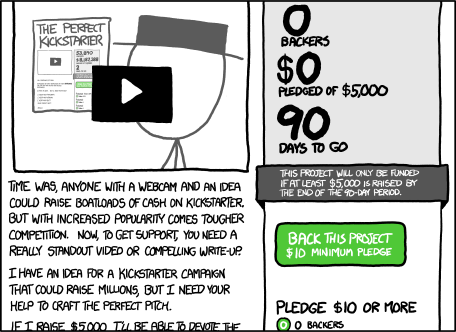
So this is the most significant point, from my point of view as a PR/Marketeer. To me, the benefits of crowd-funded projects are plainly sensible, but I can see that the model benefits businesses as well as individuals. There will, I believe continue to be an important role for publishers, and notably in providing the promotion and marketing of a project to enable it to stand out from the crowd. The XKCD cartoon above says it all: not only will you need a Kickstarter listing, your Kickstarter page has to be more awesome than every other page on the site if you want anyone to sit up and take notice.

In an environment where there's a lot of criticism over what 'value' publishers bring, expertise and scale in getting the word out about a project will be what makes some initiatives succeed where others fail. It's all well and good suggesting that 'anyone' can do this. Sure, anyone can set up a blog and have a presence, anyone can have a twitter feed and make their virtual presence felt. But there will only ever be a few who really achieve that success. For the majority, the experts in PR and Marketing will continue to play a really valuable role.

There's also potential here for publishers in supporting new authors or niche areas: drive selection via the buyers, then invest in the high quality production and add on services once there's a clear demand.

I'm excited to see where and how this evolves.

Saturday, 25 June 2011

Working my way thru the latest ebook from Problogger's Darren Rowse

So yesterday I downloaded the latest ebook from Darren Rowse, the creator of ProBlogger.

In an effort to make the most of my time reading this, I'll be working through my exercises from each chapter on here.

So, up first: competitor research.

Well, that's an interesting one for me, since really I didn't set this up with a clear audience in mind. I mainly wanted somewhere to write thoughts on my continous learning, with the aim of having something to regularly come back to when I wanted to think about my professional development. Also I guess it was a way to share thoughts on my industry and on PR. Somewhat of a surprise to me is that having not been on here for quite a while, there is nevertheless traffic coming in via 2 main sources: my LinkedIn Profile, and my Twitter feed. Well, that makes sense, since I'm more active on those channels, and my blog is linked from those channels. Sheesh. Really ought to invest some more time on here ;)

So, I guess that would mean this is a blog that is a) a shop front for me professionally, plus b) a source of information on PR and publishing, so that is how I'll pick my competitors.

1. The Google blog search
The ebook says have a dig through the search results (i.e. not just p.1) for five similar niche blogs. I started out with "PR and Publishing" as my search.

2. The top result
The top result in was http://howdoyoudo-marketing.co.uk/blog/. A nice looking site from digital marketing company "How do you do". Actually quite like this site and will be subscribing to the RSS. in terms of style (the ebook says look at this), each post has a photo/illustration at the top of the post, and is broken down into sub sections. There is some twitter activity, but low commenting on the blog itself.

3. The Case study sharer
This is a good looking blog with lots of interactive links/media: http://digital-examples.blogspot.com/. The posts are short on the whole, but always with images or video. Seems to get good traffic, and again a site I'd happily subscribe to. Amazing how much you find when you search around a little.

4. The learner
Actually this is a lot more like my own than I had realised: http://priceent08.blogspot.com/. This is a student writing about insights into the industry they want to pursue, as part of an internship at another agency. There are generally lots of images, although this does vary from post to post.

5. The uber blog
This is the "wo, how funky is this' one: http://abranddayout.wordpress.com/#!/cover. A very attractive site from a consultant, with an interesting mix of content that I would really like to read. Having said that it's the uber blog, I have to say it wasn't the easiest to navigate, and I don't think all the functionality was working on an iPad. There is however a standard version wihtout the funkiness which is better for mobile. Of all the sites, I saw the most engagement on this one, and actually that's probably down to the focus of the content, which is well written. There is again an image associated with every post.

There was a commonality across all the sites, which was the sharing of interesting finds from the industry, nothing about product or service as such. There was a good deal of advice sharing, plus some opining. This was a quick skim and I'll learn more through spending more time reading the feeds from these sites.

Wednesday, 6 October 2010

Kindle for Web

Learn about Kindle for Web here, Amazon's new tool to encourage bloggers and publishers to link back to their store by embedding a chapter or chunk of book content.

This is pretty cool. I can't recollect whether you could already do something similar with Google Book Search (some small dull memory on this makes me think that you could?) but nevertheless Amazon's Kindle portfolio is growing rapidly and there is a lot of content I'd be quite happy to feature a short section of on my own website.

So without further ado, having read all about this I headed over to the Kindle store to try it out. Could I locate a book with the 'read it for free' button? Could I 'eckers like. I tried my most recent purchases, my favourite purchases, then headed for the most popular purchases on the Kindle store. None of them. Not one. Incidentally some of the books in the top of that Kindle chart? Bizarre...

So I'm left wondering, is this launched yet? Is it for US customers only? Am I missing something? Sigh.

Tuesday, 28 September 2010

Magazines and Newspapers on the iPad

This makes me excited: Mashable posted an article recently about possible talks between Apple and publishers to get magazines and newspapers onto the iPad.

Ok you can already do this to an extent - I've bought an issue of Wired for example just to test out the functionality (watch a demo on YouTube if you haven't seen one). And you can buy single issues of various publications. Exact Editions do this for example.

But it'll be fascinating to see who Apple signs up for this, what the models will be, and how interactive the publications will be for the device.

Sunday, 26 September 2010

Book rentals: where are we heading?

Catching up on a few weeks' worth of reading this evening. Obviously, working in publishing the business models for selling book content is a fascinating and important topic for me. Particularly academic publishing. So this article from TechCrunch was an interesting one. The growth of book rentals (725% growth for one retailer mentioned in that article) is really interesting. Particularly how much growth there is in the textbook market for this model.

In a way, it shouldn't be surprising that the rental model works for students, since in a way it mirrors the the way students generally engage with their learning. They will use a particular course material for a short period of time: during a particular course or period of their learning. Once they've gained what they need from that resource, they typically don't return to it, except perhaps for revision.

But is that the way we'd actually want our students to engage with scholarly content? Unlike with a fiction title (or actually generally any read-for-pleasure title) I think textbooks are things you dip in and out of over and over again. I guess that depends how many titles, and how relevant. But I know that I still have books I had in college that I turn back to, and the same for several business titles and professional development titles, not to mention light psychology titles!

The traditional models for accessing content over and over again like this were previously: : owning a copy of a book and knowing it's there on your shelf; or having access to a library copy which you can return to over and over again when required.

There are downsides to both options which the book rentals service would suggest it gets around. For the purchase option, the book rental claims it'll save you money. For the library option, there's the risk that 10 other college kids have gone in to find the same book at the same time.

You have to remember at this point in time I'm still talking about TRADITIONAL print publishing.

So how does the rental model hold up in a digital world? When I first started reading the TechCrunch article I immediately assumed that it was digital rentals. I mean, surely in the world of iTunes that is where our rental experiences now lie? I'm amazed that a printed rental model is proving so successful and am happy to admit I have some scepticism, based on the dip-in-briefly-but-often model I set out above.

So in digital? Does Rental overshadow ownership? Digital is immediately more attractive: for one thing providers (e.g. Vitalsource) provide tools so you can annotate and add notes in a way you could never do with a loaned print copy. The model (a la iTunes) is also more familiar here, and much more accessible/immediate compared with the print rentals. But is it better than ownership?

I think I need some more time to think about this one.