All day long, on every communications channel, I have been bombarded with news about Facebook's anniversary and what it means. Happy Birthday, Facebook. Now, how about a little perspective...
Recently I came across this post via Twitter about the landscape for social networks in 2014. This maps just how broad social network use globally is. Yes, Facebook represents a very significant percentage of this map, but let's not forget just how diverse the world is.
There are some channels represented on the infographic that just don't ring as accurate to me. I find it hard to believe that some of these networks have the same active usage and engagement in 2014 as they had in their heyday. Size alone isn't interesting, or at least shouldn't be to us digital marketers. Instead, what we ought to be looking at is how active these populations are, who and how users are interacting on these sites, and how are they growing?
More to the point, what are the reasons we choose to engage with these social networks? One thing I'm certain of is that we join different sites for different reasons.
Yes, Facebook is dominating the size chart, but how many users want to receive business communication on there? I know on a personal level I still find adverts and sponsored posts on Facebook annoying. Posts from businesses, unless they're providing me with real value rather than just content updates, tend to irritate me too. What I do want from my time on Facebook is real engagement with my friends, near and far. It's helped me maintain friendships over greater distances than I could have otherwise managed. Their ten year promotion, #FacebookIs10, is actually a really smart promotion that is getting widely shared. And the reason why it resonates is because these are our personal stories. That's what Facebook means, from my point of view. I know that this won't be everyone's view, and I know some marketing communication on Facebook can be really effective, but I'm going to maintain some scepticism here.
Showing posts with label marketing. Show all posts
Showing posts with label marketing. Show all posts
Tuesday, 4 February 2014


Monday, 14 October 2013
The Marketer knows best? Timing and unsubscribes
The inspiration to get back on the blogging-wagon finally came this weekend. Into my inbox on Saturday morning came my first Christmas marketing email, courtesy of M&S.

My immediate reaction was "Noooooooo!!!!!! Way too soon to be thinking about Christmas." I posted this on Facebook, and immediately got a response from a fellow Communications professional to tell me to "Unsubscribe." This came as a surprise to me. I generally like the marketing emails I get from M&S. I like the brand and you can guarantee that I will actually be doing a lot of my Christmas shopping in there. So other than hitting the delete button I wasn't intending to take any action. Should one bad email campaign turn me off to all future campaigns?
I found myself wondering how many brands get it wrong, with trigger finger recipients like my friend immediately opting out from all future contact. Given the number of email campaigns a large business sends out, the risk of damaging those customer relationships with the wrong call to action is pretty high. So how to counter this?
Well, for one thing, one could compare the brand advocacy involved. For me, the "wrong message" (from my point of view being too early) didn't please me, but it only dented what is a strong connection between me and the M&S brand. For my colleague, there could have been a much weaker connection between her and the brand for the reaction to be so extreme. Building relationships is a huge part of what marketing and communications is about. Building up capital is achieved by getting the right messages out at the right time, and providing a pleasing brand experience again and again.
The other thing I've been wondering about is more complicated and isn't really a counter strategy at all: was the "wrong time" for me the "right time" for the majority of M&S customers? After the initial shock of thinking about Christmas in October was passed, I found myself wondering if it was me that was in the minority. There's actually only ten weeks of Christmas shopping left. That's a scary thought, but I guess some smart marketer knew that, and that October was the absolute right time to get people started on their planning. So basically, that premise that Marketing helps the consumer figure out what it is they want might genuinely be at play here…
Tuesday, 23 July 2013
Best university websites?
Ok disclosure upfront: I am a massive Pixar fan. And before that I was already a massive Disney fan. When I was at university I seriously considered writing for Disney as one of my top job options (and I wrote a screenplay and music for a "Jason and the Golden Fleece" Disney movie for my A-Levels...).
So, with that disclosure out of the way, I have been loving the promotions for the new Monsters University movie.
How far do you go to make a campaign feel real? With Monsters U, there is so much more than the average movie promotion. They have created a whole brand that mimics a real world university, including university website and twitter feed. Neither is about the movie or writes about the movie. Instead it's immersive, writing as if Monsters U is a real institution, and you might really be reaching out to students or faculty with these channels.
As the Chronicle commented in this article, the website is so good it might generate some serious envy from real world institutions! It has everything from admissions information to staff notices, school course listings and of course the university news room. The videos are slick and the whole thing is incredibly realistic.
Now bearing in mind that for Monsters Inc, Pixar generated $62,577,067 at the box office in its first weekend, you can imagine that the marketing and PR budget for the film is pretty large, which enables a campaign of this nature which requires a lengthy content plan, a large number of man hours, not to mention the upfront costs of designing and hosting all this multimedia. I still vividly remember sitting at the ALPSP annual conference back in 2010 where Grace Baynes of Nature commented that they spent several hours each day updating a single Facebook page. So how can a campaign of this nature be replicated on a smaller scale?
To create something that has a real brand, outside of the publisher brand, would need careful planning to consider the time that could be invested, and over what period. I'm curious as to Monsters U's exit strategy too. Now that the movie has hit the cinema, how long will these channels be maintained?
So, with that disclosure out of the way, I have been loving the promotions for the new Monsters University movie.
How far do you go to make a campaign feel real? With Monsters U, there is so much more than the average movie promotion. They have created a whole brand that mimics a real world university, including university website and twitter feed. Neither is about the movie or writes about the movie. Instead it's immersive, writing as if Monsters U is a real institution, and you might really be reaching out to students or faculty with these channels.
As the Chronicle commented in this article, the website is so good it might generate some serious envy from real world institutions! It has everything from admissions information to staff notices, school course listings and of course the university news room. The videos are slick and the whole thing is incredibly realistic.
Now bearing in mind that for Monsters Inc, Pixar generated $62,577,067 at the box office in its first weekend, you can imagine that the marketing and PR budget for the film is pretty large, which enables a campaign of this nature which requires a lengthy content plan, a large number of man hours, not to mention the upfront costs of designing and hosting all this multimedia. I still vividly remember sitting at the ALPSP annual conference back in 2010 where Grace Baynes of Nature commented that they spent several hours each day updating a single Facebook page. So how can a campaign of this nature be replicated on a smaller scale?
To create something that has a real brand, outside of the publisher brand, would need careful planning to consider the time that could be invested, and over what period. I'm curious as to Monsters U's exit strategy too. Now that the movie has hit the cinema, how long will these channels be maintained?
Wednesday, 17 July 2013
Blurring lines between Marketing and PR

A few weeks ago I saw an offer on one of Amazon's local deals emails for an E-Careers e-Marketing and SEO course, so decided to sign up. It was around five hours of learning in total, all delivered online, so I finally managed to squeeze it in this week.
I'd expected there to be a lot of 'new' in this course for me. I wanted to find out more about what the key differences in the Marketing approach to digital would be from the PR. I didn't get that. Instead what I found was that a good portion of this 'e-Marketing' course was about PR.
On reflection, I'm not sure that I should have been surprised about this. The more I think about it, the more blurred the lines between Marketing and PR have become now, thanks to the internet. A large chunk of the course looked at how the two disciplines now work in partnership rather than Marketing being 'advertising' and PR being 'Media'. Neither have this neat categorisation any more. Instead both groups share responsibility for engaging in a dialogue with stakeholders.
Both Marketing and PR are engaging much more in two-way dialogue. It's much less about a broadcast (although the traditional techniques of catalogues, DM etc haven't disappeared entirely, and nor should they) and much more about listening to customers, finding out what they need, and how to respond to them. I've been learning about this in PR since I first joined the CIPR back in the mid 2000s. So it was interesting and relieving to hear the same from a Marketing perspective.
It was also interesting to see how much emphasis was put on content marketing. The course pushed hard on the importance of delivering great content to stakeholders that is segmented to support their particular need. With my PR hat on, corporate blogging, thought leadership, good content and a company news room all sit within corporate communications. But this course was calling all of this 'Marketing'. So really where does the difference lie?
I found myself wondering if the biggest gap is in how businesses split up their PR and Marketing teams by stakeholder. PR remain the gatekeepers for the media and that's undisputed. They also often own what is classed as 'corporate': so news that crosses all stakeholders. But within Marketing, the stakeholders being owned by a specific Marketing team is perhaps more specific. For example within academic publishing the group that support libraries will be a Library Marketing team. And the group that support researchers will be a separate team. Or often they will be split by the type of product that they are selling. Either way, is that really the only division between a PR and Marketeer now? I'm curious for additional views on this.
A few comments on the course itself:
As I've blogged in the past about how highly I rate my MOOC experiences so far, I have to say this online course delivery was somewhat irritating in parts. The functionality was on the whole comparable: you listened to online lectures, took multiple choice quizzes, and got the option to link to further reading. Yet you couldn't pause, rewind or fast-forward through the video material. You couldn't even work out how long each segment was, you had to just wait for it to stop then click to move on.
I also couldn't quite believe that the resources being pointed to in the social media marketing section were dated from 2008. Twitter didn't even get a mention! E-Careers really ought to review how relevant their materials are.
I hate to be nit-picky, but I also fail to see how a half-day's worth of learning equates to 'mastery'. That wording on the certificates is more than a little cringey...
Sunday, 25 November 2012
Some thoughts on crowdfunding
This week's been fairly exciting in the Lucraft house, driven by the launch of Songkick's Detour initiative. So exciting in fact that, deep in conversation, Dan and I missed our train station on Tuesday night and ended up trekking through leafy Surrey in the rain trying to find our way back home...
If you are unfamiliar with Songkick, in a nutshell they make it easy for you to track bands you want to see play. This new launch is part of a growing trend of crowd-sourced funding projects, or 'crowdfunding.' In essence, pay Songkick upfront for tickets to a gig that you want to make happen. If enough people all do the same, that gig will then take place. Neat idea for fans of less mainstream artists that might not otherwise be willing to take the risk of booking a gig. This is guaranteed business: the customers have said they will pay, so the risk is removed.
The Songkick project comes not long after the launch of Kickstarter in the UK. Perhaps the best known crowdfunding site, the US version of Kickstarter launched in 2009. According to their site, since then:
In a world where new businesses can really struggle to reach sustainability, why wouldn't you start by having those people that want to buy your stuff fund your set up?
What does this mean for my industry? A search on Kickstarter brings back 340 projects in publishing. For authors in niche areas, this could have huge implications for choosing to self-publish. Before any production work is undertaken, they can identify who is going to buy their book. For the scholarly author, notably the monograph author where it isn't uncommon to sell only 50 copies of a title, this is clearly significant.
But (and this is a big but) not all projects will get funded: there are time periods set, and if funding goals are not reached, the project doesn't go ahead.

So this is the most significant point, from my point of view as a PR/Marketeer. To me, the benefits of crowd-funded projects are plainly sensible, but I can see that the model benefits businesses as well as individuals. There will, I believe continue to be an important role for publishers, and notably in providing the promotion and marketing of a project to enable it to stand out from the crowd. The XKCD cartoon above says it all: not only will you need a Kickstarter listing, your Kickstarter page has to be more awesome than every other page on the site if you want anyone to sit up and take notice.
In an environment where there's a lot of criticism over what 'value' publishers bring, expertise and scale in getting the word out about a project will be what makes some initiatives succeed where others fail. It's all well and good suggesting that 'anyone' can do this. Sure, anyone can set up a blog and have a presence, anyone can have a twitter feed and make their virtual presence felt. But there will only ever be a few who really achieve that success. For the majority, the experts in PR and Marketing will continue to play a really valuable role.
There's also potential here for publishers in supporting new authors or niche areas: drive selection via the buyers, then invest in the high quality production and add on services once there's a clear demand.
I'm excited to see where and how this evolves.
If you are unfamiliar with Songkick, in a nutshell they make it easy for you to track bands you want to see play. This new launch is part of a growing trend of crowd-sourced funding projects, or 'crowdfunding.' In essence, pay Songkick upfront for tickets to a gig that you want to make happen. If enough people all do the same, that gig will then take place. Neat idea for fans of less mainstream artists that might not otherwise be willing to take the risk of booking a gig. This is guaranteed business: the customers have said they will pay, so the risk is removed.
The Songkick project comes not long after the launch of Kickstarter in the UK. Perhaps the best known crowdfunding site, the US version of Kickstarter launched in 2009. According to their site, since then:
...over $350 million has been pledged by more than 2.5 million people, funding more than 30,000 creative projects.Staggering. Yet so plainly sensible. People have astoundingly good ideas, but don't have access to the funds to make those ideas real. Individuals can review what these ideas are, and provide support to those they would want to have access to as a consumer.
In a world where new businesses can really struggle to reach sustainability, why wouldn't you start by having those people that want to buy your stuff fund your set up?
What does this mean for my industry? A search on Kickstarter brings back 340 projects in publishing. For authors in niche areas, this could have huge implications for choosing to self-publish. Before any production work is undertaken, they can identify who is going to buy their book. For the scholarly author, notably the monograph author where it isn't uncommon to sell only 50 copies of a title, this is clearly significant.
But (and this is a big but) not all projects will get funded: there are time periods set, and if funding goals are not reached, the project doesn't go ahead.
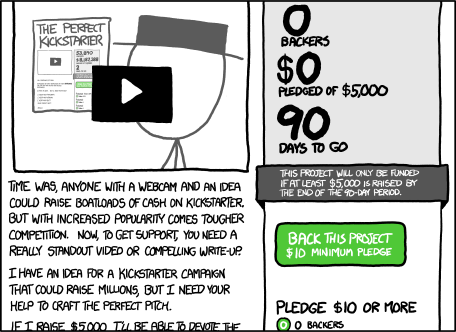
So this is the most significant point, from my point of view as a PR/Marketeer. To me, the benefits of crowd-funded projects are plainly sensible, but I can see that the model benefits businesses as well as individuals. There will, I believe continue to be an important role for publishers, and notably in providing the promotion and marketing of a project to enable it to stand out from the crowd. The XKCD cartoon above says it all: not only will you need a Kickstarter listing, your Kickstarter page has to be more awesome than every other page on the site if you want anyone to sit up and take notice.
In an environment where there's a lot of criticism over what 'value' publishers bring, expertise and scale in getting the word out about a project will be what makes some initiatives succeed where others fail. It's all well and good suggesting that 'anyone' can do this. Sure, anyone can set up a blog and have a presence, anyone can have a twitter feed and make their virtual presence felt. But there will only ever be a few who really achieve that success. For the majority, the experts in PR and Marketing will continue to play a really valuable role.
There's also potential here for publishers in supporting new authors or niche areas: drive selection via the buyers, then invest in the high quality production and add on services once there's a clear demand.
I'm excited to see where and how this evolves.
Wednesday, 14 November 2012
What does your online presence say about your personal brand?
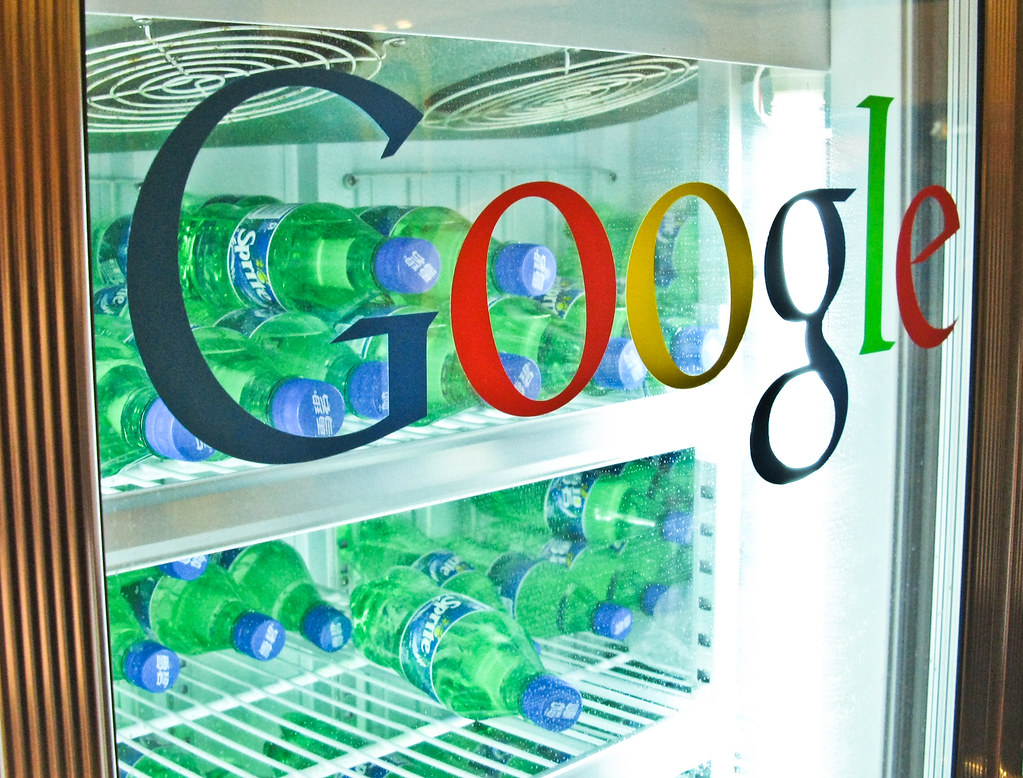
So I wouldn't describe myself as vain, but from time to time, I do check out my Google ranking. I found myself doing this today.

Firstly because I've just spent most of the last week out at meetings and conferences, which provide an amazing opportunity to meet new people who share the same fields and passions as me. Several people I met at a conference at the weekend are now connections on Twitter. Assuming they do the same thing I do when I am about to make a new connection, they would have checked out my online presence by either looking at my Twitter feed or blog.
Secondly because I just realised today, when I was researching some potential interview candidates for a job opening at SAGE, that you can no longer (could you ever?) view third-degree connections on LinkedIn unless you have a premium account. I'm not sure how long ago LinkedIn introduced premium accounts, or whether this has always been the case, but it was news to me. It made me wonder what the real value of a service like LinkedIn has for me, when what I really want to do is be able to quickly look up people that I've met at an event (or in this case that I'm about to meet), remind myself of who they are, then connect with them. So if someone is looking for that information about me, if they can't check me out on LinkedIn, where are they looking?
And thirdly because the topic of personal brand has been playing on my mind over the past few days. It started at home when Dan and I were chatting about the rise of the individual employee brand. This is a particularly hot issue in organizations driven by experts, like tech guys in start ups. They each have a personal brand tied to their expertise, which makes them credible within the tech community. But they can also use this brand to enhance that of their companies by leveraging that personal brand. As this article points out, this can be taken even further if you use the voice of your employees to create a personality for your business brand. Blog networks have been a great way to show the people behind a brand, build trust and advocacy. This in turn was fed on by conversations I had with fellow PRs up in Newcastle last Friday. We were talking about the rise of the 'CEO brand', and the power that good management of that voice can have on the broader business brand. I'm not even really talking about the much discussed 'Celebrity CEO', aka the Steve Jobs character. Rather, there are very charismatic figures at the head of organizations who use their social profiles to humanise their corporate brands. Now not everyone believes it's a good thing for CEOs to be building their social media profile, and I would agree it isn't right for every business or every industry. This Forbes post goes as far as to claim CEOs don't need to be strong communicators at all. I'm more inclined to agree with George Anders, who posts on what has worked successfully for CEOs on Twitter.
Somewhere between these three strands, I found myself wondering how sound my own personal brand is right now online. As the above shows, people are looking at your online profile. So do you know how yours looks? This Mashable article reminds us to apply what we know to be effective in PR and Marketing to our own personal identities. Here are just a few ideas:
Flickr: Aray Chen
Firstly because I've just spent most of the last week out at meetings and conferences, which provide an amazing opportunity to meet new people who share the same fields and passions as me. Several people I met at a conference at the weekend are now connections on Twitter. Assuming they do the same thing I do when I am about to make a new connection, they would have checked out my online presence by either looking at my Twitter feed or blog.
Secondly because I just realised today, when I was researching some potential interview candidates for a job opening at SAGE, that you can no longer (could you ever?) view third-degree connections on LinkedIn unless you have a premium account. I'm not sure how long ago LinkedIn introduced premium accounts, or whether this has always been the case, but it was news to me. It made me wonder what the real value of a service like LinkedIn has for me, when what I really want to do is be able to quickly look up people that I've met at an event (or in this case that I'm about to meet), remind myself of who they are, then connect with them. So if someone is looking for that information about me, if they can't check me out on LinkedIn, where are they looking?
And thirdly because the topic of personal brand has been playing on my mind over the past few days. It started at home when Dan and I were chatting about the rise of the individual employee brand. This is a particularly hot issue in organizations driven by experts, like tech guys in start ups. They each have a personal brand tied to their expertise, which makes them credible within the tech community. But they can also use this brand to enhance that of their companies by leveraging that personal brand. As this article points out, this can be taken even further if you use the voice of your employees to create a personality for your business brand. Blog networks have been a great way to show the people behind a brand, build trust and advocacy. This in turn was fed on by conversations I had with fellow PRs up in Newcastle last Friday. We were talking about the rise of the 'CEO brand', and the power that good management of that voice can have on the broader business brand. I'm not even really talking about the much discussed 'Celebrity CEO', aka the Steve Jobs character. Rather, there are very charismatic figures at the head of organizations who use their social profiles to humanise their corporate brands. Now not everyone believes it's a good thing for CEOs to be building their social media profile, and I would agree it isn't right for every business or every industry. This Forbes post goes as far as to claim CEOs don't need to be strong communicators at all. I'm more inclined to agree with George Anders, who posts on what has worked successfully for CEOs on Twitter.
Somewhere between these three strands, I found myself wondering how sound my own personal brand is right now online. As the above shows, people are looking at your online profile. So do you know how yours looks? This Mashable article reminds us to apply what we know to be effective in PR and Marketing to our own personal identities. Here are just a few ideas:
- Be consistent. I have to say, in the last three years having a strong online brand has been significantly easier than it had been prior to July 2009 for me, simply because I now have a much more unique name. I'm almost 100% certain that I am the only Mithu Lucraft in the world. That makes my search ranking almost immediately more likely to be accurate. But it isn't just about a name: having a clear naming convention across social channels helps too.
- Keep an active public profile. Regardless of whether it's just on Twitter, or using a variety of mediums, keep an active channel publicly available. Not only does this benefit search rankings but it also helps to clarify what your area of expertise and interest is. For a PR professional, being active on social media feels like a must: how can we advocate for social media if we don't understand how to use it ourselves?
- Be thematic. The best blogs I read have one consistent thread that runs through all posts. Readers then know what to expect from that blog. As this post sets out, an online presence should clarify who you are, what drives you, what your strengths are, how you're unique, and what value you bring.
- Be engaged. Don't just put messages out. Engage. Listen. Join in. Again, Twitter is such an easy channel to use for engagement: follow people that you relate to, respond to what they have to say, and have a conversation. Similarly, comment on the blogs that you rate. Build some connections, and in turn you'll find the same happens in return.
Sunday, 4 November 2012
Google inside out: 'I'm feeling Lucky' review
Time for a book review. I really enjoyed 'I'm feeling lucky: the confessions of Google employee number 59' by Douglas Edwards.
It's a fascinating insight into the world of Google from a Marketeer, from the team culture to testing, to efficiency measures, to the actual workings of the search giant. To be honest, Edwards paints it as a terrifying experience, with little trust in Marketing or PR skills, and some seriously overbearing management.
It's worth bearing in mind that this is based on the early days of Google, with less than 60 people operating in its Silicon Valley centre. I have no idea if this is reflective on life at Google now, and I'd imagine that things are a lot more structured given the size and scale of the company worldwide. But really, how scary is this:
As Edwards puts it, the start up worked its employees hard. It wasn't about trying to please the boss so much about staying on top of your workload. The recruitment of bright young things without family ties also made it easy to keep Googlers late into the night by providing high standard catering, saunas, masseurs, entertainment, sport and more. It doesn't sound so bad, if you take those benefits into account, right?
As a Marketeer, it was really interesting to read about the low cost implementation of Marketing and PR in those early days. "Efficiency, Frugality, Integrity", he writes, were the cornerstones of the Google approach. That cautiousness to spend on Marketing is something a lot of small businesses can relate to. It is even easier today, with the wide availability of white-label web options and free tools, to take this low cost approach to building a cheap yet effective marketing/PR machine for a brand, and to test how well that is working. For example for the creation of banners for contra-advertising on partner sites, instead of traditional market testing with its (often) large costs, they would test by creating one hundred banners, putting them out, and seeing which ones got the most click-throughs, then replacing those not performing.
Their approach was to favour word of mouth and free opportunities over paid. Mass media advertising was shunned. Everything should be measurable. Something tells me that times have moved on though, as advertising is now a regular occurrence, at least in London I have seen Google adverts on the tube for some time now. I'm also a big fan of their video campaigns, such as this one featuring Cambridge-based Julie Dean who launched the Cambridge Satchel Company 'from her kitchen table'. Why is this a great campaign warrants a blog post of its own, but, in brief, it takes human interest, story telling and brand values to dizzy heights. It's great.
There are some really excellent brand development insights in the book, and given that Google was in 2011 at the top of the Brand Directory's '500 top ranked brands' listing, it is a significantly important and successful brand. As Edwards writes, "a brand is the sum of all the "touch points" you have with a product or service - your interactions, your impressions, your expectations, your unplanned casual encounters." He outlines so well the trials of brand management - how do you keep that engagement across all encounters consistent?
Edwards talks about the birth of the Google Doodle, and his initial scepticism. And of the challenges of making the Doodle an internationally representative one: the Thanksgiving turkey really doesn't resonate outside the US for example. This is without a doubt one of the most recognisable features of the brand now, so demonstrates that consistency doesn't just mean what you think it does: creativity counts too.
He also talks about how they developed the personality of the brand. As Google's "word guy", he could direct the experience users had in a very direct way, by being the voice of Google on its platform. He talks about the implementation of his own voice, including cult references such as the Simpsons in error messages, and making important messages, such as the user licensing agreement, stand out with less formal copy ("It's not the usual yada yada"). Tone of voice is a really big part of the Google brand, as it is with others too, but something that really stands out in Edward's commentary as a key way Marketing and PR supported the growth and fondness of the company.
At times, there's a sense of bitterness in his tone, but this is a very enjoyable, entertaining, and seemingly honest read. There are many great lessons in the mix. He covers many of the trials Google faced, on growth, competition, privacy, and more. It's a very open (at least on the surface) look at workplace politics. One of my favourite notes of advice: "to always make the boss's idea a priority, even if it's patently unreasonable."
It's a fascinating insight into the world of Google from a Marketeer, from the team culture to testing, to efficiency measures, to the actual workings of the search giant. To be honest, Edwards paints it as a terrifying experience, with little trust in Marketing or PR skills, and some seriously overbearing management.
It's worth bearing in mind that this is based on the early days of Google, with less than 60 people operating in its Silicon Valley centre. I have no idea if this is reflective on life at Google now, and I'd imagine that things are a lot more structured given the size and scale of the company worldwide. But really, how scary is this:
"Google hires really bright, insecure people and then applies sufficient pressure that no matter how hard they work, they're never able to consider themselves successful."Ouch.
As Edwards puts it, the start up worked its employees hard. It wasn't about trying to please the boss so much about staying on top of your workload. The recruitment of bright young things without family ties also made it easy to keep Googlers late into the night by providing high standard catering, saunas, masseurs, entertainment, sport and more. It doesn't sound so bad, if you take those benefits into account, right?
As a Marketeer, it was really interesting to read about the low cost implementation of Marketing and PR in those early days. "Efficiency, Frugality, Integrity", he writes, were the cornerstones of the Google approach. That cautiousness to spend on Marketing is something a lot of small businesses can relate to. It is even easier today, with the wide availability of white-label web options and free tools, to take this low cost approach to building a cheap yet effective marketing/PR machine for a brand, and to test how well that is working. For example for the creation of banners for contra-advertising on partner sites, instead of traditional market testing with its (often) large costs, they would test by creating one hundred banners, putting them out, and seeing which ones got the most click-throughs, then replacing those not performing.
Their approach was to favour word of mouth and free opportunities over paid. Mass media advertising was shunned. Everything should be measurable. Something tells me that times have moved on though, as advertising is now a regular occurrence, at least in London I have seen Google adverts on the tube for some time now. I'm also a big fan of their video campaigns, such as this one featuring Cambridge-based Julie Dean who launched the Cambridge Satchel Company 'from her kitchen table'. Why is this a great campaign warrants a blog post of its own, but, in brief, it takes human interest, story telling and brand values to dizzy heights. It's great.
On the other side of the coin, he also talks about the lack of trust in what Marketing could offer:
"Sergey had begun doubting the wisdom of hiring marketing staff, since apparently we couldn't actually do anything for ourselves."
How is it everyone knows how to do Marketing and PR? It's one of those areas everyone has an opinion on, even the tech guys know better, according to Edwards. The copy and design on banner ads for example, or the wording in a press release, all were subject to input from all departments. Crazy. I hear designers spout similar outrage, so it isn't just my profession that suffers this. More ranting on expertise for another time though...
There are some really excellent brand development insights in the book, and given that Google was in 2011 at the top of the Brand Directory's '500 top ranked brands' listing, it is a significantly important and successful brand. As Edwards writes, "a brand is the sum of all the "touch points" you have with a product or service - your interactions, your impressions, your expectations, your unplanned casual encounters." He outlines so well the trials of brand management - how do you keep that engagement across all encounters consistent?
Edwards talks about the birth of the Google Doodle, and his initial scepticism. And of the challenges of making the Doodle an internationally representative one: the Thanksgiving turkey really doesn't resonate outside the US for example. This is without a doubt one of the most recognisable features of the brand now, so demonstrates that consistency doesn't just mean what you think it does: creativity counts too.
He also talks about how they developed the personality of the brand. As Google's "word guy", he could direct the experience users had in a very direct way, by being the voice of Google on its platform. He talks about the implementation of his own voice, including cult references such as the Simpsons in error messages, and making important messages, such as the user licensing agreement, stand out with less formal copy ("It's not the usual yada yada"). Tone of voice is a really big part of the Google brand, as it is with others too, but something that really stands out in Edward's commentary as a key way Marketing and PR supported the growth and fondness of the company.
Monday, 29 October 2012
Look for longer: a great campaign
You know you're reading a good book (which, it happens, I am) when you can't stop thinking about it, and every free minute you dive back into it. It would be fair to say the same is true for any media: really impactful TV, film, theatre and art have all done the same to me at one time or another.
This got me thinking on the way home tonight about the similar impact that marketing and advertising can have. You find yourself suddenly thinking about it or, in some cases, spending ages pouring over it, even though it really isn't something of great significance.
A case in point is a great campaign that CBS Outdoors have been running, called 'Look for Longer.' If you haven't seen it, be warned it has the potential to draw you in for some serious time wasting. In a good way. It asks you to interrogate an image with a number of London's tube stations cheekily disguised as images.

I came across it when a friend posted it to her Facebook wall. Sitting in bed, supposedly winding down, I found myself spending a good half hour looking at this picture and guessing what the pictures were. I then roped my husband into playing too. Then today, when writing this blog I just managed to spend another 20mins looking at it again!
I was at the ALPSP annual conference back in September where the oft-repeated buzzword of the event was, for me at least, 'gamification'. What a great example this campaign is. Gamification differs in some ways from the great book analogy, in that it also ties into the concept of competition. People get addicted to gaming because they are, by nature, programmed to want to do better than their peers. We want to win. I'm so interested in learning more on this that I just signed up for a Coursera module - more on that to come.
The thing about this campaign is it combines the gaming element with something visually stimulating that makes you want to look, and look for longer. And isn't that exactly what brands all want to achieve? If we're looking to engage, build brand advocates and trust, then inevitably we have to start with getting people to pay attention in the first place. Finding a hook to get people spending time on your site like this seems a great starting point to build conversation and engagement around.
This got me thinking on the way home tonight about the similar impact that marketing and advertising can have. You find yourself suddenly thinking about it or, in some cases, spending ages pouring over it, even though it really isn't something of great significance.
A case in point is a great campaign that CBS Outdoors have been running, called 'Look for Longer.' If you haven't seen it, be warned it has the potential to draw you in for some serious time wasting. In a good way. It asks you to interrogate an image with a number of London's tube stations cheekily disguised as images.

I came across it when a friend posted it to her Facebook wall. Sitting in bed, supposedly winding down, I found myself spending a good half hour looking at this picture and guessing what the pictures were. I then roped my husband into playing too. Then today, when writing this blog I just managed to spend another 20mins looking at it again!
I was at the ALPSP annual conference back in September where the oft-repeated buzzword of the event was, for me at least, 'gamification'. What a great example this campaign is. Gamification differs in some ways from the great book analogy, in that it also ties into the concept of competition. People get addicted to gaming because they are, by nature, programmed to want to do better than their peers. We want to win. I'm so interested in learning more on this that I just signed up for a Coursera module - more on that to come.
The thing about this campaign is it combines the gaming element with something visually stimulating that makes you want to look, and look for longer. And isn't that exactly what brands all want to achieve? If we're looking to engage, build brand advocates and trust, then inevitably we have to start with getting people to pay attention in the first place. Finding a hook to get people spending time on your site like this seems a great starting point to build conversation and engagement around.
Monday, 13 September 2010
Loyalty?
I was catching up on my blog feeds this morning and came across this post by Seth Godin. It's all about loyalty from customers. He makes the point that if you always delivered the best product on the market, that wouldn't necessarily engender a loyal following from your customers ("If your offering is always better, you don't have loyal customers, you have smart ones."). To have loyal customers, they have to be making a choice to buy your product service rather than look elsewhere. I won't summarise the post further than that - you can read it yourself.
What this started me thinking about was the routes various businesses take to build that loyalty, and what role marketing plays in that process. It's got to be the very values that underpin a business that dictate why a customer chooses them over another. In publishing for example, this may be in part down to the ethics of what kinds of books we'd be publishing: the topics and disciplines; the choices we make about authors' rights; the decisions we took on corporate social responsibility; etc.
I just got through reading a book (which I'll be writing a separate post about) called The E-Myth Revisited, which in one section discusses what it is that the founder of a particular company envisions for her business (a pie shop). She realises that she set up her shop as an ethically responsible, highly 'caring' company, without having done so purposefully. But having realised this, she identifies that this is what makes the shop special as a brand and has that to build on. In the publishing world again, a great example of this would be Alastair Sawday. Not only is the product he creates instantly recognizable for its personable charm, but the company itself has been set up as a highly ethical business, right through to having a small farm on site for its employees. With businesses like these two, there's a massively tangible brand value that has wide appeal to potential customers. And with such strong brand I think you are bound to garner strong loyalty.
Going back to Seth Godin's post, loyalty isn't something that is guaranteed to last. So this is the part where PR and Marketing have a key role to play. He talks about the relationships you have with loyal customers. What is your interaction? How do you reward them for being loyal?
I had someone tell me at a conference the other day that they'd spent a certain amount of money with an online retailer, and as a thank you had been given vouchers with which they could spend yet more money on that retailer's site. With offers like that, you get the double whammy of making that customer feel special, and at the same time giving them a reason to come back and shop again with you. Easier for some retailers than others? Perhaps, but it's food for thought...
What this started me thinking about was the routes various businesses take to build that loyalty, and what role marketing plays in that process. It's got to be the very values that underpin a business that dictate why a customer chooses them over another. In publishing for example, this may be in part down to the ethics of what kinds of books we'd be publishing: the topics and disciplines; the choices we make about authors' rights; the decisions we took on corporate social responsibility; etc.
I just got through reading a book (which I'll be writing a separate post about) called The E-Myth Revisited, which in one section discusses what it is that the founder of a particular company envisions for her business (a pie shop). She realises that she set up her shop as an ethically responsible, highly 'caring' company, without having done so purposefully. But having realised this, she identifies that this is what makes the shop special as a brand and has that to build on. In the publishing world again, a great example of this would be Alastair Sawday. Not only is the product he creates instantly recognizable for its personable charm, but the company itself has been set up as a highly ethical business, right through to having a small farm on site for its employees. With businesses like these two, there's a massively tangible brand value that has wide appeal to potential customers. And with such strong brand I think you are bound to garner strong loyalty.
Going back to Seth Godin's post, loyalty isn't something that is guaranteed to last. So this is the part where PR and Marketing have a key role to play. He talks about the relationships you have with loyal customers. What is your interaction? How do you reward them for being loyal?
I had someone tell me at a conference the other day that they'd spent a certain amount of money with an online retailer, and as a thank you had been given vouchers with which they could spend yet more money on that retailer's site. With offers like that, you get the double whammy of making that customer feel special, and at the same time giving them a reason to come back and shop again with you. Easier for some retailers than others? Perhaps, but it's food for thought...
Tuesday, 7 September 2010
Facebook's new universities page
Lots of coverage this week on the new Facebook Universities page. Very interesting to see what businesses are engaging with this.
The deal is the millions of students who engage with facebook every day now have a portal where they can get useful resources and information from their college or university. They can also benefit from discounts from major brands. Mashable names some of these here.
So who else will be lining up to join this list? How are universities and colleges using it? And how does it fit into their broader communications package I wonder?
There was a brilliant article in the Times Higher Education a couple of weeks ago, on how prospective students view faculty websites. I wonder what they'd make of this new page. Something tells me that putting content in a place where students spend a lot of time, compared with forcing them to go somewhere else, is bound to be a good move.
The deal is the millions of students who engage with facebook every day now have a portal where they can get useful resources and information from their college or university. They can also benefit from discounts from major brands. Mashable names some of these here.
So who else will be lining up to join this list? How are universities and colleges using it? And how does it fit into their broader communications package I wonder?
There was a brilliant article in the Times Higher Education a couple of weeks ago, on how prospective students view faculty websites. I wonder what they'd make of this new page. Something tells me that putting content in a place where students spend a lot of time, compared with forcing them to go somewhere else, is bound to be a good move.
Subscribe to:
Posts (Atom)