Wednesday, 2 January 2013

New beginnings

A very Happy New Year!

It's fair to say that 2012 isn't a year that I'll look back on with great fondness. Turning thirty brought along with it a lot of soul searching, and wondering about whether I'd achieved everything that I'd intended to in my twenties. That said, I have a habit of dwelling on the things I'm less pleased with than I do on those that I am proud of. So I wanted to take a moment to remember what was great in 2012. Not least of all because I am incredibly thankful for all these experiences, but also because this gives me a chance to consider how to keep - and to mobilise - all that was good in what I hope will be a wonderful 2013.
  1. Getting back into reading. At the start of last year, one goal I set myself was to read more, and that included stretching myself, reading outside of my comfort zone and being open to new genres. This has truly been a pleasure. Buying the iPad back in 2011 played a significant factor in enabling me to constantly have a book (or more than one) on the go at any time. I have forced myself to read in genres I wouldn't otherwise have considered, and as a result have enjoyed amazingly rich experiences. Notably I have really enjoyed reading about personal experiences in Marketing, and that's an area I'd look to find more good titles in. Access to Audible through 2012 was another really rich experience, which I had been very sceptical about when I first got started. Here, what I've found especially interesting are stories told by the author themselves. So biography is a genre I'm really beginning to enjoy more. One thing I didn't do enough of is write short reviews on every title. I have a small regret about that and it's something I'd like to get better at in 2013. 
  2. Self-improvement. A key part of the above was focusing on developing my personal skills - about a fifth of the books I read this year I selected to challenge me to think about my communication, management and leadership. From Covey's seven habits, to selected psychology, to transactional analysis, these all provided ample food for thought. I'm including a full list of my reading from the year here. 
  3. Curtains. This Kander and Ebb show was without a doubt one of the most exciting I've ever worked on. As joint choreographer for the Wimbledon Light Opera Society's production back in May, I was so proud of the team and cast - it's a wonderful show that I thoroughly loved being a part of. With the new year I'll be starting rehearsals for our next production: Anything Goes. I'm already looking forward to this so much.
  4. Granada. For my birthday I planned an escape to a city I have longed to visit since I first read about the beautiful moorish palace, the Alhambra, a few years ago. The trip was brief, but felt like a few days in paradise nonetheless. Advice to anyone considering it: stay in the old quarter, it still has that charm and sense of being lost in time. Leave a whole day for exploring the Alhambra. It's enormous, and beautiful. Make the most of the fabulous and inexpensive Cava.
  5. Podcasting. For SAGE, there was certainly a lot about podcasting this year! Although not recording them myself, it was great to learn a lot about the process, the hosting, and the promotion for two new series. As with audio books, podcasting really isn't something I'd had much previous interest in. Learning about what's available was eye-opening.
  6. Blogging. Getting back into blogging regularly isn't easy when there's always something else that needs to get done. But the impetus of being listed by the Guardian late in the year was the kick I needed to make this high on the priority list. I've also committed to taking on the CIPR Education and Skills group blog and website for 2013. That's a challenge that I anticipate will keep me focused on what's important for Public Relations in HE in a much deeper way, and help my development as much as it provides a service for the wider PR community!
  7. Eating! Dan and I enjoyed some intense culinary adventures in 2012, not least of all our summer vacation in the Lake District, where we sampled three Michelin-starred restaurants over the course of our five nights in Windermere. Cooking and eating great food is a luxury but provides a lot of enjoyment, and I'm very fortunate to have been able to do so much of it this last year.
  8. Zumba. I have to admit, I was really not looking forward to starting a generic exercise class, but in the absence of a show to work on in the second half of the year I took up Zumba, and have thoroughly enjoyed it. I've been lazy and undisciplined at the end of the year, but will be doing my best to get to a class a week whenever I can, outside of the rehearsal schedule for Anything Goes.
  9. Networking. Both for work directly and for professional PR networking, there have been some fantastic opportunities during 2012 to meet like-minded contacts, building existing connections and establishing new ones. It's such an important way to stay on top of trends, ensure best practice, and importantly just to remind yourself that you are not alone! I've been grateful for the many self-affirming conversations I've had through these events over the year.
  10. Turning thirty. So I did start the post by commenting on the dissatisfaction I felt at turning Thirty in 2012. But it was also a year of many 30th birthdays, a lot of celebrating and seeing good friends. It's good to step back and evaluate from time to time, but not to dwell. This has been a hugely positive time for me, and if anything it's made me determined to take risks, do new things, be more confident, say yes more!
I'll start the new year by looking back at just one more 'new thing' from 2012: my first (probably last too) flash mob, helping a complete stranger propose to his girlfriend. A friend received an email out of the blue, asking for singers to help him propose by singing 'their song' to his girlfriend while he proposed. Ever suckers for romance, we got together, rehearsed this number. We posed as tourists in Trafalgar Square on a cold October evening, springing on the couple as they returned from a trip to the theatre. You can see from the video the genuine surprise and delight! I can honestly say it will go down as one of the nicest things I've ever had the chance to do for someone else and reminded me how lucky I am to have someone to love too. Disgustingly soppy I know, but I've a lot to be thankful for. Enjoy:


Monday, 3 December 2012

Getting the most out of attending conferences


I spent today at another fascinating conference. Today it was the British Library's 'taking a long view on the impact of the social sciences'. For anyone not familiar with SAGE, social science is the backbone of our company and key to our mission, so immersing myself in the debates both last week and this has been fantastic.

Ordinarily I don't get out of the office all that often, but whenever I do I am strongly reminded of how important events like this are, and how valuable face to face dialogue remains even in a digital age. Building relationships is such an important part of PR, and it really is important to use the limited time we get for face to face engagement effectively.

I've blogged a little before tangentially about conferences, but tonight it felt appropriate to reflect back on making the most of the in-person event, including where and when to incorporate online tools. It should be noted that these are just my views: other tips and tricks are of course plentiful, and comments are welcomed.


  1. Get a delegate list. Obvious, but it helps so much to have had a chance to digest who is going to be attending the event with you. More often than not I'll set up a spreadsheet to examine the whole delegate list, googling names I think I know but can't remember where from, or to add background information for people I want to pick up a conversation with. Additionally it is a great way to ensure that (as the PR Manager for my company) I've prepared an adequate brief for anyone else from my senior team that might be participating. Pulling out the key influencers makes sure they make good use of their time away from the office.
  2. Check what the social media landscape is for the conference beforehand. More often than not, a conference will have an established #tag set up for the event a while before it takes place, or set up a Facebook or LinkedIn group, allowing for additional networking before delegates even arrive. See point 1), then use point 2) to really maximise the networking opportunities that this presents: you can see what people are planning to talk about, arrange to meet up with like-minded delegates, or even get questions in ahead of getting into a session.
  3. Network! Let's be frank, I HATE networking. As an introvert, the prospect of making small talk makes my insides turn over. But it's a necessary part of my job and one that anyone that wants to work at a more senior level in PR must be able to do. So my tips on doing this well? Well tips 1) and 2) are really excellent contributors to this! Again, as an introvert, having a text-based conversation, where I feel more at ease with myself, makes it possible to avoid that awkward "umm..hi!" and cuts straight to the "so I totally agree with that blog post you wrote last night." Also it never hurts to be up to speed on relevant industry headlines and issues, so you can join in with the discussion without fumbling for a point of view. Trust me if you're an extrovert and find that these sorts of things come naturally: for an introvert, being put on the spot really is painful. Other tips? I have to say I've found it much easier with practice than when I was younger: it's now less traumatic to just go up to a group and say "Hi can I join you?" Generally people are nice, and receptive to an introduction. I've met some really interesting and useful contacts this way that have often been unexpected. What also works well is listening out for the people who ask interesting questions in a particular session, mentally recording what they look like, then finding a way to chat to those attendees during a break or by finding them during another session. And the last networking tip merits a point all of its own:
  4. Plug into the digital conversation. I blogged recently about my own particular Twitter issues, but as I mentioned in that post, engaging in the conference back channel discussion on Twitter really is valuable. With relation to point 3), you get to meet a huge range of delegates and hear their views before you've had a chance to physically engage with them. As above that further reduces the need for small talk and ensures you can immediately have some great conversations with those people when you do meet face to face. Beyond networking, I also find the Twitter back channel a great way of re-emphasising the most important nuggets from a conference: it distills the sessions in a way that can trigger your memory after the event too, with tools like Storify and archiving tools collating the tweets into permanent conference notes.
  5. Swap contacts. Old school style: swap your business card. Digital style: follow your new contacts on Twitter, connect to them on LinkedIn or other networks, or super techy maybe you can bump them. Whichever method you choose, don't let the link go cold: get in touch as soon as you can after the conference ends. Which reminds me: after four days out I've got some jobs to do...


Thursday, 29 November 2012

Where am I? The missing hashtag participation mystery

This has been bugging me for a while.

For those of you who use Twitter, it's not uncommon to participate in a Twitter #tag as a back-channel to in-person conferences. For example today I was on  whilst attending a two-day conference on open access. A few weeks ago I was participating on  whilst at the Spoton conference. And interestingly one of the sessions at Spoton was actually the value of using social media channels as part of a conference: video online here.

I find tweeting through a conference, plus following others tweeting on the hashtag, a great way to get a rounded view of the session I'm in. It also gives me a great summary of the event after I've returned home. Sometimes I've even storified the tweets from events to create a permanent summary of those tweets as a narrative.

So you can imagine my frustration, when I have been tweeting like a MACHINE through a conference, to discover that the tweets I've been tagging are not appearing in the tweet stream.

Why? Is it something I said? Where am I hiding?!

Having frustratingly been invisible on my tweet stream today, I thought it was time to get to the bottom of this. Guess what? I can't.

The Twitter help page gives some suggestions on why someone would not appear in search:

On the viewer side of things: if you're viewing only top results you will be missing some tweets. Similarly not all tweets show up on a mobile.

On the tweeter side: If you have protected tweets, again these will not show up. Apparently infrequent tweeters don't appear, and neither do people with incomplete profiles. New accounts may not show up either.

But I'm none of these things!!

So here's some more thoughts from across the blogosphere:


  • I'm a spammer? If twitter sees you tweeting the same links or tweeting the same content across multiple accounts they can mistake you for a spammer. Hmm, I do tweet on the company accounts, but is that really it?
  • I'm using too many third party services: Quora reckons if you use a number of third party tweet apps, you'll also get blocked. Great, I'm definitely in that category, but that sounds plain crazy.

I love using Twitter to participate in live dialogue at events, and even though I'm not appearing in results, people who follow me can still see what I'm tweeting. It does however prevent me from really engaging with the other conference participants, and inevitably also means I'm not contributing to the discussion. I'm not alone: other colleagues have experienced the same issue, and there's a lot of internet forum discussions on this topic. If it's a problem for you too, send Twitter a complaint here!

Sunday, 25 November 2012

Some thoughts on crowdfunding

This week's been fairly exciting in the Lucraft house, driven by the launch of Songkick's Detour initiative. So exciting in fact that, deep in conversation, Dan and I missed our train station on Tuesday night and ended up trekking through leafy Surrey in the rain trying to find our way back home...

If you are unfamiliar with Songkick, in a nutshell they make it easy for you to track bands you want to see play. This new launch is part of a growing trend of crowd-sourced funding projects, or 'crowdfunding.' In essence, pay Songkick upfront for tickets to a gig that you want to make happen. If enough people all do the same, that gig will then take place. Neat idea for fans of less mainstream artists that might not otherwise be willing to take the risk of booking a gig. This is guaranteed business: the customers have said they will pay, so the risk is removed.

The Songkick project comes not long after the launch of Kickstarter in the UK. Perhaps the best known crowdfunding site, the US version of Kickstarter launched in 2009. According to their site, since then:
...over $350 million has been pledged by more than 2.5 million people, funding more than 30,000 creative projects. 
Staggering. Yet so plainly sensible. People have astoundingly good ideas, but don't have access to the funds to make those ideas real. Individuals can review what these ideas are, and provide support to those they would want to have access to as a consumer.

In a world where new businesses can really struggle to reach sustainability, why wouldn't you start by having those people that want to buy your stuff fund your set up?

What does this mean for my industry? A search on Kickstarter brings back 340 projects in publishing. For authors in niche areas, this could have huge implications for choosing to self-publish. Before any production work is undertaken, they can identify who is going to buy their book. For the scholarly author, notably the monograph author where it isn't uncommon to sell only 50 copies of a title, this is clearly significant.

But (and this is a big but) not all projects will get funded: there are time periods set, and if funding goals are not reached, the project doesn't go ahead.


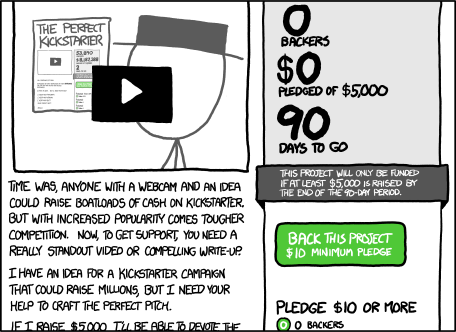
So this is the most significant point, from my point of view as a PR/Marketeer. To me, the benefits of crowd-funded projects are plainly sensible, but I can see that the model benefits businesses as well as individuals. There will, I believe continue to be an important role for publishers, and notably in providing the promotion and marketing of a project to enable it to stand out from the crowd. The XKCD cartoon above says it all: not only will you need a Kickstarter listing, your Kickstarter page has to be more awesome than every other page on the site if you want anyone to sit up and take notice.

In an environment where there's a lot of criticism over what 'value' publishers bring, expertise and scale in getting the word out about a project will be what makes some initiatives succeed where others fail. It's all well and good suggesting that 'anyone' can do this. Sure, anyone can set up a blog and have a presence, anyone can have a twitter feed and make their virtual presence felt. But there will only ever be a few who really achieve that success. For the majority, the experts in PR and Marketing will continue to play a really valuable role.

There's also potential here for publishers in supporting new authors or niche areas: drive selection via the buyers, then invest in the high quality production and add on services once there's a clear demand.

I'm excited to see where and how this evolves.

Wednesday, 14 November 2012

What does your online presence say about your personal brand?

So I wouldn't describe myself as vain, but from time to time, I do check out my Google ranking. I found myself doing this today.

Flickr: Aray Chen

Firstly because I've just spent most of the last week out at meetings and conferences, which provide an amazing opportunity to meet new people who share the same fields and passions as me. Several people I met at a conference at the weekend are now connections on Twitter. Assuming they do the same thing I do when I am about to make a new connection, they would have checked out my online presence by either looking at my Twitter feed or blog.

Secondly because I just realised today, when I was researching some potential interview candidates for a job opening at SAGE, that you can no longer (could you ever?) view third-degree connections on LinkedIn unless you have a premium account. I'm not sure how long ago LinkedIn introduced premium accounts, or whether this has always been the case, but it was news to me. It made me wonder what the real value of a service like LinkedIn has for me, when what I really want to do is be able to quickly look up people that I've met at an event (or in this case that I'm about to meet), remind myself of who they are, then connect with them. So if someone is looking for that information about me, if they can't check me out on LinkedIn, where are they looking?

And thirdly because the topic of personal brand has been playing on my mind over the past few days. It started at home when Dan and I were chatting about the rise of the individual employee brand. This is a particularly hot issue in organizations driven by experts, like tech guys in start ups. They each have a personal brand tied to their expertise, which makes them credible within the tech community. But they can also use this brand to enhance that of their companies by leveraging that personal brand. As this article points out, this can be taken even further if you use the voice of your employees to create a personality for your business brand. Blog networks have been a great way to show the people behind a brand, build trust and advocacy. This in turn was fed on by conversations I had with fellow PRs up in Newcastle last Friday. We were talking about the rise of the 'CEO brand', and the power that good management of that voice can have on the broader business brand. I'm not even really talking about the much discussed 'Celebrity CEO', aka the Steve Jobs character. Rather, there are very charismatic figures at the head of organizations who use their social profiles to humanise their corporate brands. Now not everyone believes it's a good thing for CEOs to be building their social media profile, and I would agree it isn't right for every business or every industry. This Forbes post goes as far as to claim CEOs don't need to be strong communicators at all. I'm more inclined to agree with George Anders, who posts on what has worked successfully for CEOs on Twitter.

Somewhere between these three strands, I found myself wondering how sound my own personal brand is right now online. As the above shows, people are looking at your online profile. So do you know how yours looks? This Mashable article reminds us to apply what we know to be effective in PR and Marketing to our own personal identities. Here are just a few ideas:

  • Be consistent.  I have to say, in the last three years having a strong online brand has been significantly easier than it had been prior to July 2009 for me, simply because I now have a much more unique name. I'm almost 100% certain that I am the only Mithu Lucraft in the world. That makes my search ranking almost immediately more likely to be accurate. But it isn't just about a name: having a clear naming convention across social channels helps too.
  • Keep an active public profile. Regardless of whether it's just on Twitter, or using a variety of mediums, keep an active channel publicly available. Not only does this benefit search rankings but it also helps to clarify what your area of expertise and interest is. For a PR professional, being active on social media feels like a must: how can we advocate for social media if we don't understand how to use it ourselves?
  • Be thematic. The best blogs I read have one consistent thread that runs through all posts. Readers then know what to expect from that blog. As this post sets out, an online presence should clarify who you are, what drives you, what your strengths are, how you're unique, and what value you bring.
  • Be engaged. Don't just put messages out. Engage. Listen. Join in. Again, Twitter is such an easy channel to use for engagement: follow people that you relate to, respond to what they have to say, and have a conversation. Similarly, comment on the blogs that you rate. Build some connections, and in turn you'll find the same happens in return. 

Monday, 12 November 2012

Warning: this blog post may contain strong English language

It's entirely possible that I'm a little tired and grumpy this evening, and as such, perhaps the rant which I am about to begin is a little harsh. But nevertheless it would only be a little harsh.

As a communications professional, I'm conscious of the need to think through who I contact. And to reach out to those people with relevant information. As a PR professional, if I made the grievous error of reaching out to a journalist who wasn't interested in the topic I was pitching, I'd find myself blacklisted, or even worse it would be posted about all over the internet (cf the wonderful bad pitch blog).

So it was with a little outrage that I opened an email newsletter from my alma mater this evening, the University of Durham, with the subject line "English Department Alumni Newsletter".

Why such outrage, you ask? Because I didn't study English.

Now I can see how such an error might occur. My degree did have the word "English" in the title, but I studied English Language and Linguistics, and I was registered in the Linguistics department. Not English. Durham closed my department the year I left, with the tutors moving mostly to the University of Northumbria. That felt, to me, appalling at the time, not least of all because it was one of the best courses in Linguistics in the country, but because the department received high impact scores. I'm not going to dwell on this though, because despite how it may have appeared to me, I was 21, and frankly don't really know the politics or strategic direction that the then administration based their decision on.

But while I won't dwell on the demise of the Linguistics department, I will dwell on the poor re-categorisation of a Linguistics graduate to an 'English Studies' mailing group. I won't blame the people involved with writing the newsletter, which is perfectly nice (although the e-reading interface is a little challenging and they might want to consider splitting the pages for online viewing). Where the buck stops is really in the management of alumni data at the University, wherever that sits. Is it CRM? Administration? I don't really know but this is a message to them, whoever they are:

Dear X,
I am a graduate from the University of Durham with a first class honours degree in English Language and Linguistics. Whilst that department no longer exists, at the time, it was a world-leading Social Science department. You wrote to me recently addressing me as an 'English Studies' graduate. I'm sorry, but you seem to have me confused me with an Arts student. You see, Linguistics has absolutely nothing to do with English Literature. In fact, I probably read as much literature as a plant scientist.
I spent my degree drawing syntax trees setting out grammatical sentence structures; analysing discourse; and writing out phonetic symbols. Where the English Literature scholars your newsletter addresses learned of poets and prose, and dug deep into understanding what these great works might mean, I was listening to kids learning to talk. I was watching individuals playing a game and analysing the sociological roles they assumed in a group. I was listening to accents and phonetically transcribing the sounds. I was studying people and language. I wasn't studying literature.
Other than them sharing the same symbols, they really don't have much in common. So can I have something targeted to me in my own right as an alumnus of your institution? Or does the fact that there no longer is a Linguistics department mean I am lost forever, a floating name in your CRM system without a proper category?

As I say, it's been a long day, perhaps I'm being too critical. And for the record, I absolutely loved my university experience. My heart beats a little faster when I think about how much I love Durham, how much I loved my time there. So I guess maybe that is why it's even a little sadder when my alma mater doesn't recognise me, lumps me with a group I share no affinity with, and doesn't offer me anything to engage with. Maybe I could ask the University of Northumbria to email me from their Linguistics department instead...

Sunday, 4 November 2012

Google inside out: 'I'm feeling Lucky' review

Time for a book review. I really enjoyed 'I'm feeling lucky: the confessions of Google employee number 59' by Douglas Edwards.

It's a fascinating insight into the world of Google from a Marketeer, from the team culture to testing, to efficiency measures, to the actual workings of the search giant. To be honest, Edwards paints it as a terrifying experience, with little trust in Marketing or PR skills, and some seriously overbearing management.

It's worth bearing in mind that this is based on the early days of Google, with less than 60 people operating in its Silicon Valley centre. I have no idea if this is reflective on life at Google now, and I'd imagine that  things are a lot more structured given the size and scale of the company worldwide. But really, how scary is this:
"Google hires really bright, insecure people and then applies sufficient pressure that no matter how hard they work, they're never able to consider themselves successful." 
Ouch.

As Edwards puts it, the start up worked its employees hard. It wasn't about trying to please the boss so much about staying on top of your workload. The recruitment of bright young things without family ties also made it easy to keep Googlers late into the night by providing high standard catering, saunas, masseurs, entertainment, sport and more. It doesn't sound so bad, if you take those benefits into account, right?

As a Marketeer, it was really interesting to read about the low cost implementation of Marketing and PR in those early days. "Efficiency, Frugality, Integrity", he writes, were the cornerstones of the Google approach. That cautiousness to spend on Marketing is something a lot of small businesses can relate to. It is even easier today, with the wide availability of white-label web options and free tools, to take this low cost approach to building a cheap yet effective marketing/PR machine for a brand, and to test how well that is working. For example for the creation of banners for contra-advertising on partner sites, instead of traditional market testing with its (often) large costs, they would test by creating one hundred banners, putting them out, and seeing which ones got the most click-throughs, then replacing those not performing.

Their approach was to favour word of mouth and free opportunities over paid. Mass media advertising was shunned. Everything should be measurable. Something tells me that times have moved on though, as advertising is now a regular occurrence, at least in London I have seen Google adverts on the tube for some time now. I'm also a big fan of their video campaigns, such as this one featuring Cambridge-based Julie Dean who launched the Cambridge Satchel Company 'from her kitchen table'. Why is this a great campaign warrants a blog post of its own, but, in brief, it takes human interest, story telling and brand values to dizzy heights. It's great.

On the other side of the coin, he also talks about the lack of trust in what Marketing could offer:
"Sergey had begun doubting the wisdom of hiring marketing staff, since apparently we couldn't actually do anything for ourselves." 
How is it everyone knows how to do Marketing and PR? It's one of those areas everyone has an opinion on, even the tech guys know better, according to Edwards. The copy and design on banner ads for example, or the wording in a press release, all were subject to input from all departments. Crazy. I hear designers spout similar outrage, so it isn't just my profession that suffers this. More ranting on expertise for another time though...

There are some really excellent brand development insights in the book, and given that Google was in 2011 at the top of the Brand Directory's '500 top ranked brands' listing, it is a significantly important and successful brand. As Edwards writes, "a brand is the sum of all the "touch points" you have with a product or service - your interactions, your impressions, your expectations, your unplanned casual encounters." He outlines so well the trials of brand management - how do you keep that engagement across all encounters consistent?

Edwards talks about the birth of the Google Doodle, and his initial scepticism. And of the challenges of making the Doodle an internationally representative one: the Thanksgiving turkey really doesn't resonate outside the US for example. This is without a doubt one of the most recognisable features of the brand now, so demonstrates that consistency doesn't just mean what you think it does: creativity counts too.

He also talks about how they developed the personality of the brand. As Google's "word guy", he could direct the experience users had in a very direct way, by being the voice of Google on its platform. He talks about the implementation of his own voice, including cult references such as the Simpsons in error messages, and making important messages, such as the user licensing agreement, stand out with less formal copy ("It's not the usual yada yada"). Tone of voice is a really big part of the Google brand, as it is with others too, but something that really stands out in Edward's commentary as a key way Marketing and PR supported the growth and fondness of the company.

At times, there's a sense of bitterness in his tone, but this is a very enjoyable, entertaining, and seemingly honest read. There are many great lessons in the mix. He covers many of the trials Google faced, on growth, competition, privacy, and more. It's a very open (at least on the surface) look at workplace politics. One of my favourite notes of advice: "to always make the boss's idea a priority, even if it's patently unreasonable."